Showing posts with label Inclusive pedagogy. Show all posts

Friday, February 17, 2023

Working Towards a More Inclusive Reading List within the Context of Decolonisation

Next week I'm looking forward to delivering a session on inclusive reading lists at the Quality Assurance Agency for Higher Education’s Quality Insights Conference. This is taking place fully online on 23 and 24 February so please do check out the full programme and book a place to join us! The details of my lightning talk session are below, drawing on similar themes from the recent event I presented at that focused on Decolonising the University within and Beyond the Curriculum.

This lightning talk will present visual slides to share key learning and areas for reflection with respect to auditing a reading list within the context of decolonisation. This evaluation was inspired by good practice across the sector to develop more inclusive curricula and, particularly, to diversify reading lists that will better support learning and reflect our diverse student body. The evaluation of the resources for the initial module on a Postgraduate Certificate in Learning and Teaching in Higher Education aimed to: A) evaluate how to make the reading list more inclusive of diverse authors and perspectives, and B) model good practice so that students on the module (who are also staff teaching across the university) may conduct similar work in the future. The evaluation analysis focused on ethnicity, gender, and national origin of authors. This brief presentation shares initial findings from the audit of the 2021 resources for the module (inherited from colleagues) as well as enhancements made in advance of the module running in autumn 2022. It shares reflections on the findings and also offers a provocation for others who may seek to conduct similar work in future.

By the end of this session, delegates will have reflected on the power of the resources we use in learning and teaching, and the importance of making the curriculum more inclusive. After seeing one approach to auditing a resource list and efforts to enhance it, delegates will have learnt about key findings and challenges from this evaluation.


Tuesday, June 23, 2020

Creativity and Collaboration: An Exploration of Empathy, Inclusion, and Resilience in Co-Creation of the Curriculum

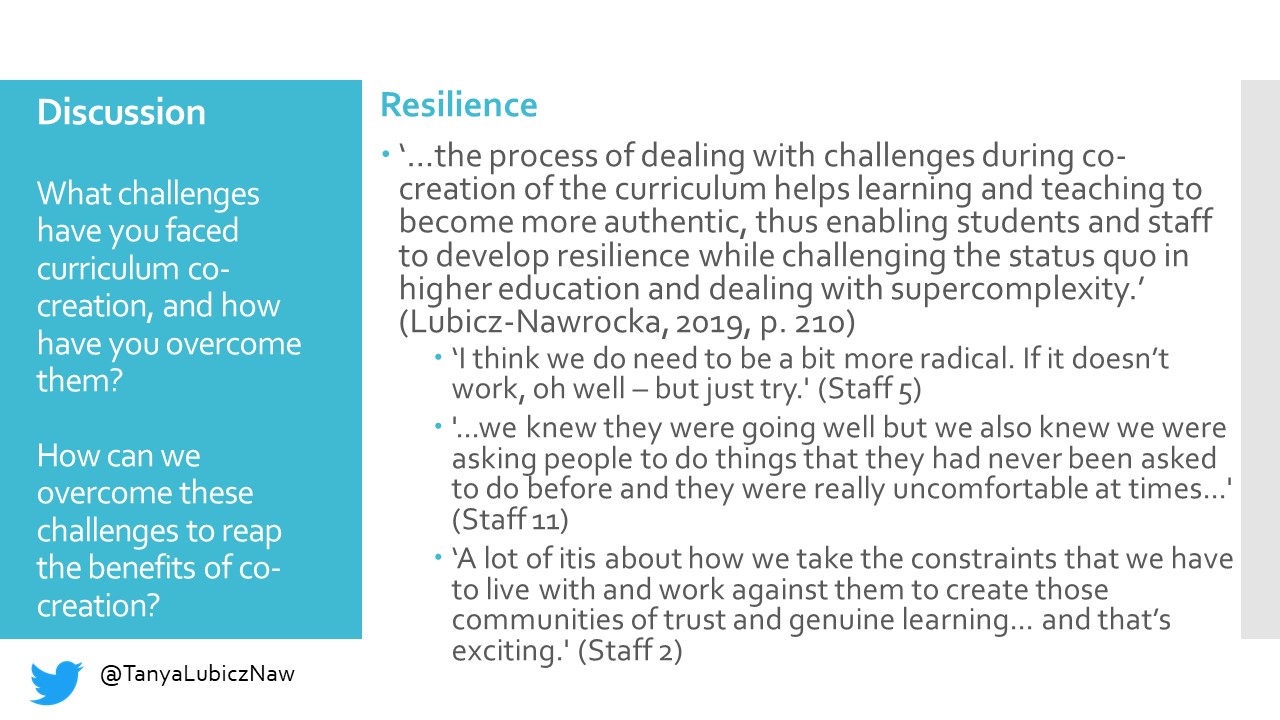
The call for papers for a special issue highlighting creativity in higher education practices inspired me to write an article drawing out the many interesting facets of creativity within co-creation of the curriculum. I enjoyed leading a discussion session today focused on the paper at the St Mary's University Festival of Learning and Teaching with this year's theme focusing specifically on co-creation of the curriculum. Thank you to the participants and chair for a fascinating discussion!

The article abstract, link to the full open access paper, and discussion questions from the session are shared below.

Abstract
This research article uses an inductive approach to analyse the nuanced nature of creativity within co-creation of the curriculum in higher education. Co-creation of the curriculum is one form of engagement in learning and teaching in which students and staff work in partnership so that each has a voice and a stake in curriculum development. Using qualitative research methods, this research focuses on the creative practices of co-creation of the curriculum and draws new connections between student engagement, creativity, and authenticity in learning and teaching. Themes that are explored include: (A) innovation through dialogue and collaboration within the community, (B) play and creatively trying new things despite risks, (C) enjoyment of creative learning and teaching, (D) shared ownership leading to intrinsic motivation and creativity, and (E) creatively challenging the status quo. The author suggests that it is the inclusive processes and products of creativity within co-creation of the curriculum that helps students and staff to develop essential skills and attributes – such as confidence, empathy, and resilience – that help them engage in authentic learning and teaching experiences and learn to cope with supercomplexity in today’s ever-changing world.

Read the full article: Creativity and Collaboration: An Exploration of Empathy, Inclusion, and Resilience in Co-Creation of the Curriculum in the Student Engagement in Higher Education Journal.


Friday, April 12, 2019

Reimagining the Place of Students in Academic Development

It's been such a pleasure to collaborate with an international team of staff and other PhD students on the journal article 'Reimagining the Place of Students in Academic Development' in the International Journal for Academic Development. I have learnt so much from Peter Felten, Sophia Abbot, Jordan Kirkwood, Aaron Long, Lucy Mercer-Mapstone, and Roselynn Verwood as we developed the ideas and 'reimaginings' of student-staff partnerships in academic development. Use the link above for free access to the article, and see the abstract below:

As calls for student-staff partnership proliferate across higher education, academic development must re-examine and reimagine its relationship to students. Students generally occupy roles with limited agency in academic development. We argue that this needs to change. We propose re-articulating the purpose of academic development toward the creation of conditions that liberate everyone involved in teaching and learning in higher education. We offer four vignettes that illustrate what is possible when students have the opportunity to embrace their essential roles. We conclude by reflecting on the human implications of student agency in academic development and higher education more broadly.

Friday, December 14, 2018

Reflective Essay: Co-Researching Co-Creation of the Curriculum

Last year, I shared on this blog some of my reflections on co-researching co-creation of the curriculum and my experiences of working with students as partners as part of my PhD research in this area. After this time, I was thrilled that Hermina Simoni wanted to carry on this partnership work by writing a reflective essay about our experiences of using arts-based methods together, and that she shared with me about co-production in her subject area of health care. I learnt a lot throughout this collaborative work, and I'm thrilled to now share our work in our new publication.

Co-researching co-creation of the curriculum: Reflections on arts-based methods in education and connections to healthcare co-production
International Journal of Students as Partners

Summary of our reflective essay:
Our research explores how students and staff can both benefit from participating actively in partnerships in higher education. Through qualitative research employing focus group discussions with students and then with staff, participants suggest a plethora of practices of co-creation of curriculum whilst also reflecting on benefits and challenges. The inclusion of two student consultants as co-researchers added another layer to this research project by engaging students as partners in learning and bringing multiple voices to the research collection, analysis, and dissemination processes. The inclusion of undergraduate student co-researchers’ perspectives offers a mirror in which we can observe what is needed to foster effective co-creation of the curriculum in higher education. This reflective essay illustrates perspectives about our experiences of engaging in this collaborative research using deliberative democratic methodology. The scope of this paper is to provide an informative picture about our experiences, draw connections with co-creation of healthcare, and encourage similar partnerships in education and beyond.

I hope you enjoy reading the full reflective essay via the IJSaP website.

Saturday, September 8, 2018

ECER 2018 - Educational Inclusion

The European Conference of Educational Research (ECER) was hosted this year in the beautiful town of Bolzano, Italy in the Dolomites at the crossroads between Italian, Austrian, and Swiss borders. The Free University of Bozen-Bolzano hosted us, and I was fascinated to learn that their degree programmes are all trilingual. This set the stage for gathering education researchers from all over the world.

At such a big conference with 33 parallel sessions running at the same time, of course each participant navigates their own course through the conference proceedings and events. In this post, I attempt to summarise some of the take-aways throughout my conference journey this week.


Space to Reflect, Learn, and Make New Connections
I enjoyed attending the presentation by Labake Fakunle and Joceline Alla-Mensah sharing Universas21-funded work looking at the benefits and barriers of doctoral students’ engagement at networking events and conferences. Their participants cited financial barriers and time constraints as challenges, but they also saw great value in networking at conferences. This was certainly the case for me in attending ECER and, thanks to the Moray House Graduate School’s financial support and my ability to take a week of annual leave from my work, I was supported to attend ECER. As with the AERA and JURE conferences, I found great benefits to taking the time to learn about a wide variety of educational research, reflect on and share my own work, and connect with individuals researching similar topics. This was particularly the case at the Universitas21 FINE networking event (which I will write about separately soon) and the ECER networking events in the town plaza and at the Mareccio Castle which was a fabulous experience.


Inclusion through Sharing Values
There were some fascinating keynote talks and symposia that highlighted and problematised the conference theme of inclusion. Brahm Norwich emphasised how inclusion is respectful to all participants or partners by valuing the contributions of all, but he also noted that inclusion has become a popularised term in the current society. For example, co-researching has become a popular method to include participants’ voices more actively in research design and direction. Kyriaki Messiou provided some rich examples of including children’s voices actively in school improvement projects and research when they draw ‘power maps’ of where decision-makers are located within the school, take photos of where they do and do not feel safe to improve the learning environment, and write a ‘message in a bottle’ to share their wish list of other improvements. Messiou shared how inclusive research that challenges traditional power dynamics can empower all participants, and I similarly found the experience extremely valuable when co-researching with undergraduate students

Both Messiou and, in his keynote, Thomas Popkewitz, highlighted that inclusion represents our values. Although power dynamics are always present, they are made more transparent in some ways by showing how decisions are made and creating spaces for shared ownership (as in benefits of co-creation of the curriculum). At the same time, though, including sometimes may mean excluding others who don’t share our values and we need to be attentive to this exclusion. This made me reflect on how whether co-creation practitioners may exclude traditionalists when challenging the status quo of the traditional university hierarchies, processes, and structures.


Inclusion through Creativity and Play
In some cases, inclusion can mean inviting other individuals into existing spaces to contribute to decision-making. For example, Manuela Raposo-Rivas and Kyriaki Messiou each showed in different research in the UK and Spain how children can be invited into adult spaces to contribute to decision-making and the learning of both new and experienced teachers. Furthermore, Demet Lukuslu showed in the Partispace project how youth were invited into adult-led spaces in youth councils in Turkey. While these forms of inclusion are positive, they are operating within existing structures.

Because of my interest in creativity and play in teaching outside the box, I enjoyed learning about other examples at ECER of creating new, creative spaces for inclusion. For example, Bernadette Mercieca showed how the framework of well-known children’s literature such as Alice in Wonderland, the Wizard of Oz, or Little Red Riding Hood could be used as metaphors in a doctoral thesis to make concepts more accessible or understood in different ways as they resonate with readers. I was fascinated by this idea! In a session on gamification, Lina Higueras-Rodriguez and Esra Demiray each shared interesting presentations about gamification of learning to promote new spaces for engagement. These presentations led to a fascinating discussion about how ‘game’ and ‘play’ are two distinct concepts in English but, in Spanish, one word is used for both. We discussed the distinctions, and what we felt were playful methodologies versus traditional methodologies which that promote engagement. There are interesting connections to be made between play, gamification, and engagement in learning.


Inclusion through Teaching Excellence
I enjoyed hearing a number of papers on teaching excellence. For example, Sofia Chanda-Gool presented on university teachers in England fostering learning environments that promote a wellbeing framework; she found that these inclusive environments increase students’ sense of belonging, as well as their confidence to engage in groupwork and take risks in learning. Similarly, Mercedes Inda-Caro presented on Spanish teachers’ ‘activating teaching’ methods that develop learning environments that foster student engagement. Salvador Reyes-de Cozar also presented on the importance of counselling and student support, and the need for teachers to recognise students who are struggling and to provide support. Each of these three research presentations had similar findings to my own research into student perceptions of excellence in teaching and student support.

Thinking back on Thomas Popkewitz’s fascinating keynote presentation, he suggested that curriculum outcomes reflect individuals’ hopes and what we want students to become in our society. He argued that educational work and research are based on these aims and values, even when purporting to be objective. I reflected on the many different stakeholders in education and their various perceptions of teaching excellence

However, throughout the massive conference programme of 3,000 presentations centred around the theme of inclusion, it was striking that seeing students as partners and/or working with them to co-create the curriculum within secondary and higher education was almost non-existent. For me, this speaks to the need for university teachers and researchers to not only listen to students’ feedback and use their data in research, but to become more inclusive by working with students as collaborators. After all, if partnerships with children are successful, secondary and undergraduate students are more than capable! Perhaps the bigger question is whether academics are willing? Hopefully we can have some blue-sky thinking.


Tuesday, May 22, 2018

Students as Partners in Learning and Teaching: The Benefits of Co-Creation of the Curriculum

I'm delighted that my newest research article, Students as Partners in Learning and Teaching: The Benefits of Co-Creation of the Curriculum, has been published in the International Journal for Students as Partners. This work builds on my previous work looking at the benefits (and challenges) of co-creation while extending new arguments about how co-creation helps students and staff to develop self-authorship that help them deal with challenges in the supercomplex world we live in.

See the abstract below:

This research explores the benefits of co-creation of the curriculum, which is seen as one form of student-staff partnership in learning and teaching in which each partner has a voice and a stake in curriculum development. This qualitative research analyses participants’ perceptions of co-creation of the curriculum in the Scottish higher-education sector. Initial findings show that some staff and students participating in co-creation of the curriculum perceive it to benefit them by (a) fostering the development of shared responsibility, respect, and trust; (b) creating the conditions for partners to learn from each other within a collaborative learning community; and (c) enhancing individuals’ satisfaction and personal development within higher education. Using Barnett’s conceptualisation of supercomplexity and Baxter Magolda’s three-pronged view of self-authorship, the author suggests that critical and democratic engagement in co-creation of the curriculum can develop the self-authorship of both students and staff members, including their cognitive, interpersonal, and intrapersonal abilities which help them adapt to an ever-changing, supercomplex world.

Read the full article.

Tuesday, April 10, 2018

Student perceptions of teaching excellence: an analysis of student-led teaching award nomination data

I am thrilled that my co-authored paper on student perceptions of teaching excellence was published in the journal Teaching in Higher Education. This research article culminates several years' work of supporting student-led teaching awards at Edinburgh University Students' Association, sharing the research previously via presentations and an internally produced report (see my previous blog post), and now engaging in this article with scholarly literature and theories of teaching excellence.

I'm able to provide access for the first 50 individuals to receive free online copies of the article via this link, and see the abstract below:

This research explores student voice and student perceptions of teaching excellence in higher education, and authors suggest implications for student engagement and student/staff partnerships in teaching and learning. Edinburgh University Students’ Association facilitates the longest-running student-led teaching awards in the UK, receiving 2000–3000 open-ended student nominations annually which raise the profile of teaching and reward strong teachers. These extensive qualitative data were analysed using aspects of a grounded theory approach to investigate student perceptions of teaching excellence. This research identified four key themes of teaching excellence: (1) concerted, visible effort; (2) commitment to engaging students; (3) breaking down student-teacher barriers; (4) stability of support. This paper explores these themes with respect to theoretical work on teaching excellence and suggests that students’ perceptions of excellence in teaching and student support advance notions of ‘critical excellence’ and ‘moral excellence’.

Read the full article.


Wednesday, November 8, 2017

Educational and International Thematic Connections

With my new role at Edinburgh University, I've been enjoying hosting a study visit of twenty Chinese headteachers. We began the visit on Monday with sessions at Moray House to show them the long history of teacher education there, followed by a Scottish welcome dinner hosted at the City Chambers to celebrate strong partnerships between Scotland and China.


After great sessions yesterday at Moray House on the Scottish policy context and teacher professionalism and standards, theory was really brought into practice today during a fantastic visit to Dunbar Grammar School today. It was also my first visit to a Scottish high school, so I was quite interested in the visit and any thematic connections with my higher education research. The Headteacher gave an overview of his growing school community, the curriculum, and their School improvement plan. He highlighted student choice in the curriculum (which is much greater at this high school compared to elsewhere) and the breadth of subjects including health and wellbeing, computing, business, and home economics. Furthermore, the Headteacher emphasised the importance of not only teachers' and parents' voices but also pupils' voices contributing to the revised curriculum and the school improvement plan. It was great to hear the Headteacher speaking about the importance of student voice and student engagement.


The Chinese Headteachers really enjoyed the tour of the school, bringing it to life as they saw cooking classes, science, art, and PE. They even were able to see a social studies  class where students were being taught to think for themselves and articulate what they would do if they were President Trump with regards to building a wall with Mexico. The Headteacher emphasised of course that students were not being influenced in what to think (and could lose their job for this) and instead were learning how to think critically and substantiate their arguments with research they could do on their mobile phones in class.


We were all impressed to see the fantastic inclusive education support provided by the Pupil Support Workers both inside and outside the school including mindfulnesss sessions, trips to the beach, hiking, gardening, working on a farm, outdoor cooking, and building relations with local elderly residents (for which they won a national award for partnership).


The Chinese Headteachers were also very interested to hear about the support provided to newly qualified teachers by both the school and the local authority. They saw how new teachers needed to meet General Teaching Council Standards for Registration, and keep up their standards through continuing professional learning. They were particularly interested in performance management of staff who did not meet the standards, which is an important issue that can arise across all education contexts internationally. In looking at the similarities and differences between secondary and higher education, I was reflecting on how universities offer the PG Certificate in Academic Practice to new lecturers and opportunities for academic staff to earn Higher Education Academy Fellowship, but they do not tend to have strong performance management processes for staff who do not excel in teaching.


Last but not least, we enjoyed learning about and seeing the various technology used in the high school. This included EdBuzz Google resources, email for submission of homework, collaborative areas where teachers could share resources, the Pupil Record System, students' digital portfolios of their progression records to document their learning, Kahoot online quizzes which  students could complete using smartphones, and ShowMyHomework to document homework for students and their parents. They also were able to learn about student voice including the prefect system, student council, and surveys. They saw student feedback forms (including questions on enjoyment of learning, academic challenge, and the quality of feedback provided by teachers) and learn how they are used as one way to monitor and support teacher performance.


It was a fantastic visit and it was especially interesting to focus on themes of student voice in the Scottish education system, student curricular choice, technology in the classroom, and inclusion. There are such interesting connections between these themes in secondary education which carry on into higher education. It was also fascinating to explore sometimes tricky issues such as smartphone use in the classroom, dealing with student behaviour issues, and processes for teacher performance management which are not often spoken about in higher education.

Friday, March 24, 2017

sparqs Conference 2017

Yesterday I participated in the Student Partnerships in Quality Scotland (sparqs) conference, which was a great day of meeting students and staff to hear about their work in student engagement, particularly in quality assurance and enhancement processes. I had previously attended the sparqs 2015 conference, and I had loved the focus on co-creation of the curriculum and student/staff partnerships during fascinating talks and innovative workshops. Two of these workshops were particularly memorable for me to this day, one led by University of Lincoln where we used Legos to build collaborative environments for partnership work. The second was led by South Lanarkshire College, New College Lanarkshire, and Glasgow Caledonian University where we used helium balloons and weights to symbolise how to overcome challenges of student delivery of staff development sessions in practice. These were particularly fun workshops, and they helped me learn about great partnership work taking place across the UK.


This year’s sparqs conference had a really interesting international dimension. Shirley-Anne Somerville MSP kicked off the day with an interesting speech on how Scotland leads the way internationally in including students in quality processes, and it was good to hear her speak about how student/staff partnerships in Scottish universities and colleges are key to the wider success of the country. This was followed by Adam Gajek, Executive Committee Member of the European Students’ Union. It was helpful to hear him speak about how student engagement in quality enhancement processes helps democratise education within universities and colleges (which should model democracy for the wider society), and it also helps students to develop the skills and attributes to excel as active citizens in democratic societies. These are also themes that are arising in my research on the effect of co-creation of the curriculum in the Scottish higher education sector, so it was great to see these synergies. Adam also spoke about the threats to democracy in higher and further education as being the commercialisation of education and also students’ lack of participation. In my research on student engagement, it is also increasingly clear that not only students have the responsibility to engage but also university staff and university policies more widely need to take responsibility for facilitating students’ participation and engagement.


In the afternoon of the conference, it was fantastic presenting with two students who have been contributing to my research as Student Consultants. We presented the findings from our student focus groups to show Class Reps’ perceptions of the benefits and challenges of engaging in co-creation of the curriculum, as well as enablers to facilitate partnership practices more widely in universities. We also reflected on our own experience of co-producing research together (see my additional reflections in my previous post). They did a fantastic job with the presentation, and it was a great experience for us all working together on this research so presenting it was a great culmination of our project.

See a copy of our presentation of 'Co-Creation of Research on Co-Creation of the Curriculum'.

Our presentation was followed by two other great presentations from the University of Glasgow about co-creation and student/staff partnerships. The first highlighted a great project in which students co-created chemistry lab films to help future students prepare for labs and better understand how to complete laboratory procedures. These students were adding what they felt was missing from the curriculum and increasing other students’ confidence before going into the labs. It was great to see the positive impact of this project with the next year’s cohort receiving higher average marks (and especially seeing how the lowest mark jumped from 41% to 61%!). Not only did the co-creation experience help other students, but it was wonderful to see how the project helped the student co-creators to develop skills including teamwork, communication, public speaking, creativity, critical thinking, and digital skills. I was very impressed by their presentation, and it was also great to hear about the Press Start student-led journal allowing students across disciplines to be involved in writing, reviewing, editing, and publishing their work about gaming studies. I hope more students interested in gaming are able to get involved in the future so this project continues to grow.


In the last conference session, I really enjoyed going to the session on international perspectives on student engagement and quality assurance. Especially since I had studied abroad as an undergrad at the University of Canterbury in Christchurch, New Zealand, it was interesting to learn about their different tertiary and higher education sector and the challenges they faced including the how policies had reduced the number of student representatives and their inclusion on committees, the strong consumer model of education, and how recently membership of student unions had become voluntary and weakened the ability of student unions to make an impact. I hope that student representation can overcome these challenges to improve engagement with quality processes in New Zealand in the future. It was also interesting hearing more about the EU-funded project Enhancing Student Participation in Quality Assurance (ESPAQ) in Armenia, especially since I am really looking forward to visiting Armenia in a few weeks to contribute to this project! I’m looking forward to sharing more about this experience in the coming weeks.

The 2017 sparqs conference was a really interesting and varied one, and it was great to conclude it with the sparqs awards. I was delighted that our Teaching Awards research project on student perceptions of teaching excellence was shortlisted for the award recognising the best Scottish partnership initiative between a University and a Students’ Association. Sadly, we did not win but it was fantastic that Edinburgh University’s Project Myopia was runner-up for the best student-led project to promote equality and diversity! Well done to them – it was fantastic to see these students’ co-creation of the curriculum project being recognised for its impact in liberating and diversifying the curriculum.


Monday, February 27, 2017

Reflections on Co-Researching Co-Creation of the Curriculum

In my application for Innovative Initiative Grant funding for a project researching student and staff perceptions of co-creation of the curriculum, I felt an innovative aspect of this project could be involving students as research consultants. Their role was to contribute the student perspective to analysis of the student focus group data, and to help co-lead the focus groups for academic members of staff. Therefore, I would be able to experience an element of co-creation within my research on this subject, so it was particularly relevant and topical. I was delighted to receive the small grant which would enable me to compensate the Student Consultants a bit for their work. This project was also accepted to be presented at the Student Partnerships in Quality Scotland (sparqs) conference in March 2017, so another great opportunity arose at that conference for the students to co-present the work together with me.

I wasn’t nervous before leading the student focus groups with student representatives since this was not too dissimilar to other events I run at the Students’ Association to contribute to student representatives’ training and skills development. This time, though, I was excited to share my own work and the area of student/staff partnerships in co-creating the curriculum with them since I wanted to share this interest and I thought many would be interested in this idea. What I was nervous about ahead of the focus groups was in how to present the Student Consultant opportunity. What if no one was interested?

Risk is a theme that has been arising in my qualitative data from interviews I previously conducted with both staff and students who have participated in co-creation of the curriculum. Staff felt a sense of risk that students would not engage with their work, and another sense of risk in not knowing the direction of their collaborative work to develop an aspect of the curriculum together since this would depend on the ideas and consensus within the group. Furthermore, students can feel a sense of risk in taking more ownership over their learning, feeling more accountable to the learning community than in traditional courses, and not knowing what to expect from this non-traditional teaching. However, it was interesting for me to feel this sense of risk and nervousness myself while I wondered if any students would want to work with me on the project. If they didn’t, then a core aspect of my ‘innovative’ project would not work and it would no longer be very novel. Therefore, I put in quite some time into designing a handout to promote the role and getting the wording right so it was clear yet hopefully enticing and not over-promising anything or asking too much of the students.
 

Luckily for me, I had five students email me to express their interest in the two Student Consultant roles. It was a difficult decision because all of the student focus group participants had provided valuable contributions, and especially these students. Two students in particular wrote about how much they had enjoyed the project, what they could contribute to it, and what skills and experience they felt they could gain by participating – I offered them the roles but it was difficult turning the other students down.


We have now met once to co-analyse the focus group data, after finally finding a time we could all meet. We had all read through the transcripts of the two focus groups (about 20 pages each!) and the students had been very conscientious in their preparations and notes about their reflections which led to a valuable discussion. We had very similar interpretations of the data relating to students’ aims in higher education, students’ views of effective teaching, and their perspectives on student engagement. All of us had been surprised that the first focus group (which neither of them had been a part of) had been a bit negative about the idea of co-creation of the curriculum. Several participants in that focus group had complained about the heavy workload of preparing ahead of a flipped classroom experience, they felt there was no benefit in attending if they did not have time to prepare adequately, and even when they had prepared some of these students had felt that the discussion was too ‘out of the box’. Both the Student Consultants and I were surprised that these participants had previously spoken about the need for students to take responsibility for their learning experience; furthermore, they had voiced the view that effective teachers should adapt to students’ interests and act on students’ feedback to improve the course as it takes place. Therefore, we felt it was contradictory that these participants had highlighted many challenges to co-creation of the curriculum when, in other parts of the discussion, it seemed that they would have benefited from and enjoyed experiencing co-creation of the curriculum. By contrast, the second student focus group (which both Student Consultants had been part of) was generally very positive about the opportunities that co-creation present.


We are still analysing the focus group data, and we are preparing for leading the two focus groups with staff on 10 and 13 March
. One of the Student Consultants has volunteered to create the short PowerPoint sharing the general consensus from the student focus groups, which will be presented after the staff share their perspectives so that we can discuss the comparison. My first gut reaction was to think ‘What if the presentation isn’t good?’ but immediately I felt that it would be ok since part of the process of co-creation is letting go of ownership over the direction of the project. From what I hear from staff who have done this, often the students go above and beyond the staff members’ expectations and produce exceptionally high-quality work when they’re given this opportunity. If they don’t, then we can have a productive discussion and give each other feedback to improve the presentation, but I’m confident I’ll be pleasantly surprised by the output. We’ll see!

Update: read more about our presentation and experiences at the sparqs conference.


Saturday, January 21, 2017

The Power of Co-Production: Transforming Ourselves and Our Society

Today was a thought-provoking day attending and presenting at the conference 'Co-Production, Research and Youth and Community Work'. Dave Beck’s conference introduction started the day rightly linking co-production to social justice and community development that decrease inequalities and effect positive change in civically engaged democracies. Co-production helps to develop shared ownership as opposed to chasing extrinsic motivations and targets for their own sake. It was good to start the day with these themes which would re-emerge in numerous presentations and workshops. In particular, this fit well with the opening presentation from Young Edinburgh Action’s young people and staff. I was particularly struck by how they said they created ‘safe spaces, and brave spaces’ for young people to participate in co-production and have a positive impact on their community. 
As I have found in my emerging research, community development, trust and respect are key to developing and working effectively within safe spaces; at the same time, co-production challenges traditional power hierarchies and stereotypes about what young people are capable of, so co-production also needs to be ‘brave spaces’ that challenge the status quo and think creatively to tackle challenges in the classroom or community, and beyond in the wider society. Preparations for my workshop helped me articulate my initial analysis of some of my data from staff and students who have participated in co-creation of the curriculum, and I was glad that it led to fruitful discussions of the democratisation of knowledge, sharing power amongst a collective, and developing power within individuals.
Other presentations brought this out for me by discussing how co-production is fundamentally a developmental process of empowerment. Within safe spaces, people can bravely experiment and learn creatively from challenge whilst developing personally and professionally as individuals and whilst developing society’s capacity to confront some of the most difficult challenges of today’s uncertain world, such as inequality. By developing personal agency and empowerment, we can learn to understand ourselves better by demonstrating reflexivity and transparency. By working in partnership with others in co-production projects, it can be an emancipatory, transformative and holistic process that is rooted in individuals’ personal stories and in real life. Although co-production is ‘messy’, challenging, and involves risk, it was helpful to see that others agreed that its transformative power often outweighs these challenges since it has the ability to change ourselves and our society for the better.

Wednesday, April 1, 2015

Social Justice and Inclusive Pedagogy

I recently went to a talk by Dr Lani Florian on social justice and inclusive pedagogy. She spoke of how difference has been often positioned as a problem. However, with the increasing diversity of students and vulnerabilities, her research had focused on understanding differences to understand students' different outcomes.

Dr Florian made really interesting points about the assumptions that teachers make about school-aged students, their abilities and their potential. This is something I have been thinking a lot about lately since often teachers of higher education also make assumptions about their students' knowledge and prior learning experiences which can be quite different from the reality for many students.


Based on her research, Dr Florian argued for the need for teaching pedagogies that promote whole-class engagement and inclusivity rather than perpetuating differences in practice for presumed group differences. This doesn't hold other students back but, rather, acknowledges that differences are to be expected between students and accommodates differences inclusively. 

Dr Florian, speaking about school-aged students, argued that we need to reconceptualise differences between learners as opportunities for teaching. I would agree from the perspective of student/staff partnerships of co-creating the higher education curriculum. These dialogues and collaborations recognise students' wide variety of prior learning experiences, preferred learning pedagogies, and future goals to be more inclusive and (so it seems) help students achieve much more from their studies. I hope that my research can build on Dr Florian's work and look at higher education and how this may be possible.