I was delighted to lead a webinar on curriculum co-creation, exploring its potential for enhancing student wellbeing, for the QAA Scotland Enhancement Theme collaborative cluster on mental wellbeing. See a recording below if you are interested in these themes.
Showing posts with label community. Show all posts
Showing posts with label community. Show all posts
Friday, September 4, 2020

Sunday, August 23, 2020
Free Webinar: Curriculum Co-Creation and its Potential for Transforming Student Wellbeing
I'm delighted to have been invited to speak at the Quality Assurance Agency (QAA) Scotland webinar on 1 September (10am - 11am BST) on my research. I will outline current principles and understandings of curriculum co-creation, drawing from my research. I will provide practical examples of co-creation practices and outcomes, focusing on themes relating to student mental wellbeing and learning and teaching transformation.
This webinar will explore:
- Key principles of curriculum co-creation
- Practical examples of co-creation practices and outcomes
- The connections between curriculum co-creation and student mental wellbeing
Learn more and register for the free webinar on the QAA Scotland Eventbrite page.
Tuesday, June 23, 2020
Creativity and Collaboration: An Exploration of Empathy, Inclusion, and Resilience in Co-Creation of the Curriculum
The call for papers for a special issue highlighting creativity in higher education practices inspired me to write an article drawing out the many interesting facets of creativity within co-creation of the curriculum. I enjoyed leading a discussion session today focused on the paper at the St Mary's University Festival of Learning and Teaching with this year's theme focusing specifically on co-creation of the curriculum. Thank you to the participants and chair for a fascinating discussion!
The article abstract, link to the full open access paper, and discussion questions from the session are shared below.
Abstract
This research article uses an inductive approach to analyse the nuanced nature of creativity within co-creation of the curriculum in higher education. Co-creation of the curriculum is one form of engagement in learning and teaching in which students and staff work in partnership so that each has a voice and a stake in curriculum development. Using qualitative research methods, this research focuses on the creative practices of co-creation of the curriculum and draws new connections between student engagement, creativity, and authenticity in learning and teaching. Themes that are explored include: (A) innovation through dialogue and collaboration within the community, (B) play and creatively trying new things despite risks, (C) enjoyment of creative learning and teaching, (D) shared ownership leading to intrinsic motivation and creativity, and (E) creatively challenging the status quo. The author suggests that it is the inclusive processes and products of creativity within co-creation of the curriculum that helps students and staff to develop essential skills and attributes – such as confidence, empathy, and resilience – that help them engage in authentic learning and teaching experiences and learn to cope with supercomplexity in today’s ever-changing world.
Read the full article: Creativity and Collaboration: An Exploration of Empathy, Inclusion, and Resilience in Co-Creation of the Curriculum in the Student Engagement in Higher Education Journal.


The article abstract, link to the full open access paper, and discussion questions from the session are shared below.
Abstract
This research article uses an inductive approach to analyse the nuanced nature of creativity within co-creation of the curriculum in higher education. Co-creation of the curriculum is one form of engagement in learning and teaching in which students and staff work in partnership so that each has a voice and a stake in curriculum development. Using qualitative research methods, this research focuses on the creative practices of co-creation of the curriculum and draws new connections between student engagement, creativity, and authenticity in learning and teaching. Themes that are explored include: (A) innovation through dialogue and collaboration within the community, (B) play and creatively trying new things despite risks, (C) enjoyment of creative learning and teaching, (D) shared ownership leading to intrinsic motivation and creativity, and (E) creatively challenging the status quo. The author suggests that it is the inclusive processes and products of creativity within co-creation of the curriculum that helps students and staff to develop essential skills and attributes – such as confidence, empathy, and resilience – that help them engage in authentic learning and teaching experiences and learn to cope with supercomplexity in today’s ever-changing world.
Read the full article: Creativity and Collaboration: An Exploration of Empathy, Inclusion, and Resilience in Co-Creation of the Curriculum in the Student Engagement in Higher Education Journal.


Sunday, May 6, 2018
Forum for International Networking in Education (FINE)
It was a fantastic experience to attend the
Forum for International Networking in Education (FINE) meeting and events around the American Educational Research Association (AERA) conference in New York a few weeks ago, representing
Moray House School of Education at the University of Edinburgh. I attended the FINE Forum as well as their networking events and some of their events in partnership with the AERA Graduate Student Council such as the Human Library Panel Session: Conversations on Global and Local Educational Topics. It was an
extremely valuable experience for networking, hearing interesting talks, and
also gaining helpful tips to enhance the PhD experience.
Several themes emerged throughout the FINE
discussions, including the following tips which were shared with me which I hope to pass on to you here!


Depth,
breadth, and interdisciplinarity
It was highly recommended by more senior academics that early career researchers should have not just
breadth but also depth in your work and, specifically, 'programmatic research' that builds coherently and extends on previous work. Furthermore, reading
outside of your subject area, engaging in interdisciplinary work, and taking
risks by being open to different opportunities and interdisciplinary work was highly emphasised. For
instance, Associate Professor Susan Bridges (Assistant Dean for Curriculum Innovation, University of Hong Kong) spoke about the value of making career choices based on what
opportunities are most exciting or fun, and she described how sometimes unexpected experiences or
roles can have a massive, positive impact on your career and satisfaction of
working in academia. Go on – be bold and creative even if it may seem like a
non-traditional choice or a risk. (My previous post on teaching outside of the box seems relevant here, as well as the Fearless Girl statue facing the bull at Wall Street which I saw during my visit.)

Although the AERA conference is focused on
current American educational research and an overwhelmingly American audience, it
was refreshing that the FINE meetings connected colleagues from around the
world based at Universitas21 institutions. The FINE sessions emphasised seeing internationalisation as an
opportunity and not an imposition, as well as seeing the power of
interdisciplinary work across borders. Especially for those of us who are engaging in research
on more controversial topics that unpick power dynamics (I'm thinking here about my work on challenging the status quo to embed partnership), the mentors at the
FINE meetings encouraged early career researchers to be true to why we joined
the academy. In this sense, networking and building relationships with
colleagues was seen as a powerful way to humanise us and so that others may be more receptive to the controversial aspects of
our work.


Networking
and collegiality: draw from the power of groups
The FINE events, jointly run conference
sessions with the AERA Graduate Students’ Council, and the breakfast and
reception events were great opportunities for networking with other PhD
students from around the world as well as more experienced colleagues. I really
enjoyed making new connections with others from the University of Auckland,
University of British Columbia, University of Connecticut, and Nottingham
University as well as reconnecting with a colleague from Hong Kong University
who I previously met at the JURE EARLI conference last summer (see a photo of us at AERA below)!

While attending conferences, presenting, and publishing your work, it was highly recommended to contribute to
and learn from the collegiality of academia. This includes valuing the feedback
from peer reviewers and colleagues to help you improve your work. I have found the peer review process immensely helpful for my own work. This also
includes engaging in and drawing on the communities within our departments.
While it was helpful hearing about how other PhD students work with their
supervisors on research, have active communities where senior academics and
also early career researchers mentor PhD students, it made me think that Moray
House was missing a trick here and could do much more to promote a sense of
community which appears to occur in other education schools. For example, some schools hold 'PhD Days' where all in a cohort would present a poster or a three-minute-thesis-style talk to their colleagues and receive feedback. I think this would be an extremely valuable exercise which would help our community be more inclusive and supportive while letting us get to know others' research and any synergies with our own.
Crafting
your teaching identity
During the FINE sessions, Gladis Kersaint (Dean of Neag School of Education, University of Connecticut) emphasised the importance
of teaching in a scholar’s career. She noted that the focus tends to be on
one’s research identity rather than teaching (which was a theme re-emerging throughout FINE events and my own research which I hope to write about more in the future). However, it is important to gain teaching experience (even if guest lecturing or creatively teaching in other areas) and to reflect on your teaching identity.
Later in the FINE meetings we learnt more from Alison Milner and Jennifer Tatebe (FINE Leadership Team Members) about how to articulate our teaching philosophy
well to potential employers. They emphasised that this is a
self-reflective portrait of teaching beliefs that demonstrates your key
teaching experience and shows a strong understanding of your students, and can draw on Chism's (1998) five components of the teaching philosophy.
It is not only important for recruiters but also for your own professional
development. It should illustrate a few key teaching moments that illustrate
your teaching philosophy, show synergies with your research, and – especially
if being submitted with a job application – draw out synergies with the
institution’s values and priorities.

Research
for meaningful impact
Everyone focused on the importance of
publishing to advance your career in academia and share your work. However, it
is also important to have meaningful impact by sharing research beyond academia
by informing the public of your research and its implications. This includes
sharing your work on Twitter, blogs such as this one, or newspapers. An example
was that, for every journal article you publish, you should either write a blog
post or opinion editorial piece to share your work more broadly.
Ways
to ‘do it all’ – co-creation of research
Both Marc Beauchamp (Associate Dean of Research, University of British Columbia ) and Andy Noyes (Head of School of Education, University of Nottingham) shared insightful
reflections about engaging in co-creation of research with students. Marc spoke
about ‘teaching like a rockstar’, by which he meant excellent student-centred
teaching where faculty and tutors can work in partnership with undergraduate
students to mentor them and involve them in their research (this sounds like other great examples that I saw in my research on student perceptions of teaching excellence).
Andy also
emphasised ‘teaching like a troublemaker’ and not just focusing on efficient,
‘what works’ teaching methods since it is important to develop students’
criticality. He also suggested that one way of doing this is to not see a
teaching/research dichotomy but to do your research through your teaching by
involving students (see my reflections on doing that through co-researching co-creation of the curriculum).
We also discussed how there has been so little resolution
in the teaching/research dichotomy in the last few generations. Perhaps co-creation
of the curriculum is a solution by involving students more in our teaching
decision-making and in our research? Rowena Arshad (Head of Moray House School of Education, University of Edinburgh) spoke powerfully about the
importance of knowing and trusting our students, and the opportunities that
co-creation of the curriculum can present.

Concluding
remarks
The FINE forum and events surrounding
the AERA conference provided valuable panel discussions, networking
opportunities, and food for thought. It was great, too, to be part of the FINE
collaborations with the AREA Graduate Students’ Council and to have the
opportunity to attend such a wide range of other conference sessions at AERA (more to come on this soon on my blog). I
really enjoyed hearing tips from senior academics, and it is good to end on
their wise suggestion to own the privilege but also the responsibilities that
come from being part of academia, and to enjoy the journey as an early career
researcher by exploring and maintaining the feelings of excitement resonating
with why we originally started our PhDs.
 |
| Our Moray House School of Education team at FINE 2018 |
Monday, April 9, 2018
Teaching Outside the Box
Last week I participated in a workshop led by the Institute for Academic Development on ‘teaching outside the box’. I really enjoyed the first half of the session when we worked collaboratively in groups to define ‘creativity’ and then to define ‘teaching’ separately, followed by the development and critique of our own definitions of ‘creative teaching’.

First, it was striking that for our group and for the others, the words we associate with creativity (such as ‘play’, ‘originality’, ‘engaging’, ‘exciting’, ‘dynamic’, and ‘fun’) tend to be much more positive than the words associated with teaching (‘lecture’, ‘content’, ‘learning community’, ‘collaboration’, ‘boring’, ‘contained’, and ‘should be fun’). This was a bit depressing, especially when thinking about recapturing the excitement of lectures to be, as Cathy Bovill suggests, as exciting as an adventure in Legoland® or reflecting on how creative teaching such as co-creation the curriculum benefits both students and staff by developing increased engagement with and enjoyment of learning.

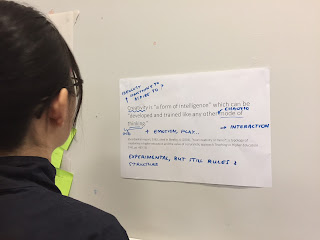
It was challenging to create a concise yet all-encompassing definition of ‘creative teaching’. Our group came up with: a flexible and fun process that actively engages students and teachers in a challenging, collaborative learning experience. We wanted to emphasise that creative teaching can and should be messy and challenging, but it can also be extremely rewarding, meaningful, and beneficial for both students as staff when they overcome challenges together (for example, see my previous post about my research article). I enjoyed seeing the other groups’ definitions of creative teaching, for example the one that emphasised the tools, concepts, actions, and aspects of reflection that are embedded in creative teaching. By using stickers, it was also helpful to see which concepts resonated most with the group.

This exercise and subsequent collaborative review and critique of various definitions of creativity were extremely interesting and also beneficial for my forthcoming article on creativity in co-creation of the curriculum, which draws on some of my recent research and a presentation on creativity in learner engagement. It was helpful to have the space to step back from day-to-day activities and reflect on these concepts through having meaningful conversations with colleagues.
The second half of the workshop consisted of unstructured exploration of five different types of creative teaching methods, but unfortunately the lack of structure or case studies of how these activities were used in the classroom made the activities fall a bit flat. For me, this emphasised how creativity and fun can be important aspects of teaching excellence, but they can’t be implemented superficially just for the sake of it and need to be incorporated alongside clear learning expectations to add to and enhance engagement with academic subject content. See my previous work on teaching excellence and my article addressing challenges of co-creation for more on this, and stay tuned for my research article on creativity.

First, it was striking that for our group and for the others, the words we associate with creativity (such as ‘play’, ‘originality’, ‘engaging’, ‘exciting’, ‘dynamic’, and ‘fun’) tend to be much more positive than the words associated with teaching (‘lecture’, ‘content’, ‘learning community’, ‘collaboration’, ‘boring’, ‘contained’, and ‘should be fun’). This was a bit depressing, especially when thinking about recapturing the excitement of lectures to be, as Cathy Bovill suggests, as exciting as an adventure in Legoland® or reflecting on how creative teaching such as co-creation the curriculum benefits both students and staff by developing increased engagement with and enjoyment of learning.

It was challenging to create a concise yet all-encompassing definition of ‘creative teaching’. Our group came up with: a flexible and fun process that actively engages students and teachers in a challenging, collaborative learning experience. We wanted to emphasise that creative teaching can and should be messy and challenging, but it can also be extremely rewarding, meaningful, and beneficial for both students as staff when they overcome challenges together (for example, see my previous post about my research article). I enjoyed seeing the other groups’ definitions of creative teaching, for example the one that emphasised the tools, concepts, actions, and aspects of reflection that are embedded in creative teaching. By using stickers, it was also helpful to see which concepts resonated most with the group.

This exercise and subsequent collaborative review and critique of various definitions of creativity were extremely interesting and also beneficial for my forthcoming article on creativity in co-creation of the curriculum, which draws on some of my recent research and a presentation on creativity in learner engagement. It was helpful to have the space to step back from day-to-day activities and reflect on these concepts through having meaningful conversations with colleagues.

The second half of the workshop consisted of unstructured exploration of five different types of creative teaching methods, but unfortunately the lack of structure or case studies of how these activities were used in the classroom made the activities fall a bit flat. For me, this emphasised how creativity and fun can be important aspects of teaching excellence, but they can’t be implemented superficially just for the sake of it and need to be incorporated alongside clear learning expectations to add to and enhance engagement with academic subject content. See my previous work on teaching excellence and my article addressing challenges of co-creation for more on this, and stay tuned for my research article on creativity.
Saturday, January 21, 2017
The Power of Co-Production: Transforming Ourselves and Our Society
Today was a thought-provoking day attending and presenting at the conference 'Co-Production, Research and Youth and Community Work'. Dave Beck’s conference introduction started the day rightly linking co-production to social justice and community development that decrease inequalities and effect positive change in civically engaged democracies. Co-production helps to develop shared ownership as opposed to chasing extrinsic motivations and targets for their own sake. It was good to start the day with these themes which would re-emerge in numerous presentations and workshops. In particular, this fit well with the opening presentation from Young Edinburgh Action’s young people and staff. I was particularly struck by how they said they created ‘safe spaces, and brave spaces’ for young people to participate in co-production and have a positive impact on their community.
As I have found in my emerging research, community development, trust and respect are key to developing and working effectively within safe spaces; at the same time, co-production challenges traditional power hierarchies and stereotypes about what young people are capable of, so co-production also needs to be ‘brave spaces’ that challenge the status quo and think creatively to tackle challenges in the classroom or community, and beyond in the wider society. Preparations for my workshop helped me articulate my initial analysis of some of my data from staff and students who have participated in co-creation of the curriculum, and I was glad that it led to fruitful discussions of the democratisation of knowledge, sharing power amongst a collective, and developing power within individuals.
Other presentations brought this out for me by discussing how co-production is fundamentally a developmental process of empowerment. Within safe spaces, people can bravely experiment and learn creatively from challenge whilst developing personally and professionally as individuals and whilst developing society’s capacity to confront some of the most difficult challenges of today’s uncertain world, such as inequality. By developing personal agency and empowerment, we can learn to understand ourselves better by demonstrating reflexivity and transparency. By working in partnership with others in co-production projects, it can be an emancipatory, transformative and holistic process that is rooted in individuals’ personal stories and in real life. Although co-production is ‘messy’, challenging, and involves risk, it was helpful to see that others agreed that its transformative power often outweighs these challenges since it has the ability to change ourselves and our society for the better.
Monday, July 11, 2016
Tips for Creating Open Badges
After I first heard about Open Badges two summers ago, I was keen to adopt them into my work in academic engagement at Edinburgh University Students’ Association and over this time the project has been extremely successful. Open Badges are flexible, free, digital forms of accreditation that are full of information (metadata) about what individuals have done to earn them. They are open source and hundreds of organisations and companies around the world use them. The Open Badge scheme I set up at Edinburgh University Students’ Association was the first Scottish higher education scheme, but now increasing numbers of universities across the UK and around the world are adopting them – the more Open Badges are used, the more widely recognised and valuable they will become.
 This past year I have tried to share my experiences of setting up an Open Badge scheme with as many people as possible within the higher education community. I have published a case study about my experiences of setting up and piloting Open Badges, led workshops at conferences to help others learn how to incorporate Open Badges into their own work, and responded to many enquiries from individuals across the country.
I now want to consolidate all of my tips in one place, so keep reading to see my advice!
Clarify Your Aims: How Will Open Badges Benefit Students and How Will they Benefit Staff?
I have found that Open Badges have a large number of benefits, but it’s important to be clear about how they benefit students (i.e., why they should bother earning them) and how they benefit staff at your organisation (i.e., why it’s worth the effort to develop them). Below are examples of benefits relating to the support I give to Class Reps at the Students’ Association.
Benefits for Students:

Think About the Bigger Picture: Develop Clear Criteria and a Framework for Your Badges
While you can create a one-off Open Badge, it’s best to think about the bigger picture: will your Open Badges be part of a framework for your activity, or within a bigger framework with your organisation? You should have a think about what activities you want to incentivise students to take part in and make sure this fits in with the benefits you aim to have for your scheme. If others within your organisation also offer Open Badges, how will your scheme fit in (separately or together?) and will it be the same level of difficulty to earn badges offered by different areas of your organisation?
For Class Reps, you can see the image above of the many activities we see as part of the Class Rep role. When students earn three badges in one category, they will earn that category-level badge. When they earn all three category-level badges, they will earn the Class Rep Gold Badge. Based on feedback from students we didn’t create a bronze, silver, and gold scheme since students didn’t like the idea of going from all being equal to suddenly being in a tiered scheme. We wanted to give Class Reps lots of choice and flexibility so we developed these broader categories.
For the criteria, we usually required students to use a blog post to explain: what they did and what the impact was for themselves and/or others. For example, in the Implementing Change badge acknowledges the Class Reps who schedule individual meetings with University staff members to bring their peers’ concerns forward and find potential solutions. Students will have to write up a brief report on their work implementing change, including:
Open Badges can be ‘triggered’ by different things. In my understanding, there are three ways to issue an Open Badge:
Before setting them up, make sure you have:
Don’t Forget the Marketing and Support
It is important to get the marketing right for your Open Badges so you promote them to students by selling the benefits to them, explain what your badges are, and clarify how students can earn them. I developed handouts that I made available at various events I ran, and I also included the handouts in our VLE for Reps so they were all aware of the opportunity to earn Open Badges.
Some students I work with have never written a blog post before and were nervous about that, so I worked with colleagues to develop some optional training sessions. We offered Blogging for Reps with tips about how to write effective online content, engage audiences, and be clear about what you want to say. We also offered a peer support session where Reps would have a go at writing a blog post and give feedback to peers on their drafts. This proved really helpful.
 Clarify What Success Means for Your Open Badges
In your scheme, does success mean the quantity of badges students earn or the quality of their engagement? As you will see in the infographic, our Open Badges have had strong impact in the quantitative sense with over 1,300 Reps earning at least one badge (for the online training). However, we were just as interested in the quality of engagement of our Reps, and as you will have seen in the Benefits section above the Open Badges helped Reps reflect on their experiences and helped us learn about their work across the University. We learnt about how they developed communications, change management, and leadership skills as well as much more! See my case study in the Journal of Educational Innovation, Partnership, and Change for a fuller look at what this qualitative impact meant for us.
Need More Support than I Can Offer?
I hope by sharing my experiences and tips this has helped you to think through how to create your own Open Badges. You can find lots of great resources to help you create them at http://openbadges.org/http://openbadges.org/ and http://www.digitalme.co.uk/.
 This past year I have tried to share my experiences of setting up an Open Badge scheme with as many people as possible within the higher education community. I have published a case study about my experiences of setting up and piloting Open Badges, led workshops at conferences to help others learn how to incorporate Open Badges into their own work, and responded to many enquiries from individuals across the country.
I now want to consolidate all of my tips in one place, so keep reading to see my advice!
Clarify Your Aims: How Will Open Badges Benefit Students and How Will they Benefit Staff?
I have found that Open Badges have a large number of benefits, but it’s important to be clear about how they benefit students (i.e., why they should bother earning them) and how they benefit staff at your organisation (i.e., why it’s worth the effort to develop them). Below are examples of benefits relating to the support I give to Class Reps at the Students’ Association.
Benefits for Students:
- Better understanding all aspects of the role, and serving as stepping stones to the Edinburgh award for representing students
- Reflecting on and documenting their work
- Sharing best practices with Reps in other schools who may be working on similar issues
- Sharing their work & successes with the students they represent (see examples of anonymised blog posts on our Schools pages in the ‘news’ tab for each)
- Earning open badges and adding them to their LinkedIn profiles
- Fewer questions about the Class Rep role and, in particular, what activities are part of the Edinburgh Award for Reps
- Learning more about the local work of Reps in their School (there are over 2,000 Reps at Edinburgh University who work locally within subject areas and Schools)
- Learning more about the impact of the student Rep role on students’ personal and professional development
- Having access to fantastic blog posts that we can include on our Schools webpages
- Providing a new form of recognition for our Reps who are volunteers (see more in the sparqs accreditation report – my example of Open Badges is on pages 10- 12)

Think About the Bigger Picture: Develop Clear Criteria and a Framework for Your Badges
While you can create a one-off Open Badge, it’s best to think about the bigger picture: will your Open Badges be part of a framework for your activity, or within a bigger framework with your organisation? You should have a think about what activities you want to incentivise students to take part in and make sure this fits in with the benefits you aim to have for your scheme. If others within your organisation also offer Open Badges, how will your scheme fit in (separately or together?) and will it be the same level of difficulty to earn badges offered by different areas of your organisation?
For Class Reps, you can see the image above of the many activities we see as part of the Class Rep role. When students earn three badges in one category, they will earn that category-level badge. When they earn all three category-level badges, they will earn the Class Rep Gold Badge. Based on feedback from students we didn’t create a bronze, silver, and gold scheme since students didn’t like the idea of going from all being equal to suddenly being in a tiered scheme. We wanted to give Class Reps lots of choice and flexibility so we developed these broader categories.
For the criteria, we usually required students to use a blog post to explain: what they did and what the impact was for themselves and/or others. For example, in the Implementing Change badge acknowledges the Class Reps who schedule individual meetings with University staff members to bring their peers’ concerns forward and find potential solutions. Students will have to write up a brief report on their work implementing change, including:
- the problems they raised with the staff member
- the solutions they proposed
- staff response and action
- how the Rep communicated with other students to let them know about the positive changes that were implemented (or the reasons why the idea could not be implemented)
Open Badges can be ‘triggered’ by different things. In my understanding, there are three ways to issue an Open Badge:
- Successful completion of an online quiz or online module (automatic badge release upon minimum threshold grade being achieved – we use this for when students earn over 80% on our Class Rep online training quiz and they earn the online training badge)
- Participation in an event, training, conference, etc. (manual grade centre updates to trigger badges – we use this to input attendance into our virtual learning environment to issue the intermediate training badge)
- Graded blog posts (manual grading is needed here and we have student staff members help with this, but we use a grading scheme as simple such as 0 for not meeting badge criteria and 1 for meeting the criteria and issuing the badge)
Before setting them up, make sure you have:
- a good name for each badge that students and others outside your organisation (such as employers) can understand
- a description including the criteria needed to earn each Open Badge
- a specific grade centre column to link to each badge (badges will be triggered when grade is equal to or greater than 1 in my case)
- an image for your Open Badge
Don’t Forget the Marketing and Support
It is important to get the marketing right for your Open Badges so you promote them to students by selling the benefits to them, explain what your badges are, and clarify how students can earn them. I developed handouts that I made available at various events I ran, and I also included the handouts in our VLE for Reps so they were all aware of the opportunity to earn Open Badges.
Some students I work with have never written a blog post before and were nervous about that, so I worked with colleagues to develop some optional training sessions. We offered Blogging for Reps with tips about how to write effective online content, engage audiences, and be clear about what you want to say. We also offered a peer support session where Reps would have a go at writing a blog post and give feedback to peers on their drafts. This proved really helpful.

In your scheme, does success mean the quantity of badges students earn or the quality of their engagement? As you will see in the infographic, our Open Badges have had strong impact in the quantitative sense with over 1,300 Reps earning at least one badge (for the online training). However, we were just as interested in the quality of engagement of our Reps, and as you will have seen in the Benefits section above the Open Badges helped Reps reflect on their experiences and helped us learn about their work across the University. We learnt about how they developed communications, change management, and leadership skills as well as much more! See my case study in the Journal of Educational Innovation, Partnership, and Change for a fuller look at what this qualitative impact meant for us.
Need More Support than I Can Offer?
I hope by sharing my experiences and tips this has helped you to think through how to create your own Open Badges. You can find lots of great resources to help you create them at http://openbadges.org/http://openbadges.org/ and http://www.digitalme.co.uk/.
Sunday, July 3, 2016
Telling the Story of Your Research
During the end of last week, I was thrilled to participate in the workshop 'Telling the Story of Your Research' at Moray House Graduate School of Education. This was the culmination of five months of working with my PhD student colleagues Carla, Krystallia, and Rebekah to gain funding, plan, and develop this workshop (see my blog post on our journey). On Thursday, fourteen of us PhD students came together for the first time to reflect on our own PhD journeys and share them with each other.


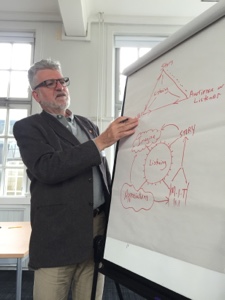
The first morning started with Michael Williams, our storytelling facilitator and guide, telling us that, 'In the end, you need to tell a good story in your thesis and defence'. We discussed the importance of engaging stories that connect with the audience and allow our stories to resonate with them. Our first activity involved using the metaphor of a tree to have us visualise and draw the outline of our stories. We started with the roots to show our diverse backgrounds and motivations for conducting the PhD. Then we moved on to show the root of our work, including the systems and people supporting our journeys. Next we moved to the leaves to show our aims, the fruit showing where we get our energy and passion, and what nourishes us throughout the journey. Finally, we drew the compost bin of things we have already gotten rid of or want to get rid of (such as anxiety or fears of not being good enough to survive this journey).
Next, we went around the circle one by one to share our personal stories and listen to others' stories about their PhD journey. This was a pivotal part of the workshop, since we went to being individual PhD students in the same workshop to developing a sense of community with trust and support in the room. Since I am a part-time student who is not often at Moray House, I knew some of the participants but I didn't know much about their research. For those who I knew better, I had talked with them or had watched their academic presentation of their work but I didn't know their motivations for undertaking the PhD journey. It was wonderful to hear everyone's story, not selecting just a few people to volunteer, because it helped our group come together knowing that everyone would share their story, and everyone would also listen to and give appreciation for others' stories. We were putting ourselves into the story of our research by showing our personal motivations and sharing our motivations and aims.
Through the sharing of our stories and giving appreciation for others' work, it was wonderful to see themes and synergies arise between our research. Many of us are looking at how to tackle inequalities, inclusivity of diversity, and how to tackle complex problems in today's society by using education. Several of us are also looking at creativity and play in different levels of education, and it was wonderful to hear Patrick's definition that 'creativity is the empowerment of people, allowing their voices to be heard. As I discussed in a previous blog post, creativity and play is a theme that I want to look into more and read up on in my own work. Many of us are working to engage students in their own learning, from the nursery level to primary, secondary, and higher education levels too so it was helpful to hear different perspectives on that. It was courageous that many shared their fears of education not being valued by society or that they don't have what it takes to excel in academia, but it was wonderful to see the hope that all of us have that our work can effect positive change in the world around us.
After the first day of the workshop, I think we all felt excited yet exhausted from the mental work of the day searching inside ourselves to tell our story and listen, sometimes emotionally, to others' stories. We returned for the next day of the workshop with anticipation of new workshop activities helping us to tell our story and to pass through the Hero's Quest. This second day began with a fun activity to help us listen to a partner's story, only asking 'why' and helping them delve deeper into their story. Then, we began role playing the PhD Hero's Quest, with one PhD student making the journey and entering several stages of thoughtful questioning by the others. It was an extremely helpful experience to think of what the viva may entail, and it was also extremely supportive.
Participating in the storytelling workshop was a great experience and I was so glad to see it come together. I developed better connections with my PhD peers, personally by connecting to the story of what drew each of them to their research and also academically by finding connections my their work and my own. I also found it an extremely beneficial experience for stepping back and reflecting on my own journey while practising telling my story and learning how to engage audiences better in future presentations and other situations. I think all of us recognised the clear need for other such workshops that help develop our personal skills as well as our professional skills, promote reflection, and allow us to enhance both our pastoral and academic experience as a PhD student. For me, it drew me into our PhD community and was invaluable in helping me to develop strong connections with my PhD colleagues. I hope that others will organise similar workshops in the future! A massive thank you to the EUSA Schools Fund, EUSA Global Fund, and the Moray House Graduate School for providing the funding to make this possible.
Wednesday, June 29, 2016
The Work and Benefits of Student Engagement
It’s been nearly five months and the big day has nearly
arrived – in this time, I have not only been researching student engagement as
a PhD student and working full time, but I have also been working with three other PhD colleagues
(Carla, Krystallia, and Rebekah) to apply for funding and plan an innovative
storytelling workshop for our colleagues. As I’m pretty busy with my job and PhD (some say I'm crazy!), I was
at first apprehensive about taking on the extra commitment of helping in this endeavor.
However, I felt I should practice what I preach and do a bit more engaging in
my student role to contribute to the PhD community at Moray House Graduate
School of Education and Sport.
Carla, Krystallia, Rebekkah, and I have written four funding
proposals, three of which came together from the EUSA Schools’ Fund, EUSA
Global, and the Graduate School to generously fund our endeavor. Throughout
this time, it has been a great opportunity for me as a part-time PhD student to
get to know these colleagues better and work collaboratively with them which
has been beneficial when PhD work can be so solitary. It has helped us develop
our resilience and perseverance to write the funding requests, liaise with
funders, the storyteller, caterers, etc. When we launched the event, it was
fantastic to see all the spaces fill up within 24 hours showing great demand
even in the midst of summer holidays. It is now with great anticipation and
satisfaction that we’re looking forward to seeing our event come together
tomorrow as ‘Telling the Story of Your Research: A 1.5-Day Storytelling
Workshop for Academics’. You can follow our journey at #MHresearchstories
on Twitter to see how we get on.
We’re hoping to see many benefits of the workshop tomorrow,
seeing our PhD community come together whilst learning about each other’s
research. We will also learn to communicate more effectively, reflect more on
our research journey, construct new knowledge, and capture the complexity of
our research in an audience-friendly manner (not bore them!). Personally I’m
hoping this workshop will help me to improve my presentation skills in telling
the story of my research to engage various audiences, and I look forward to
hearing feedback from my peers whilst enjoying the event.
I hope we will see more such
student-organised events in our community soon!
Tuesday, June 21, 2016
World Yoga Day
Happy World Yoga Day! I used to wonder what all the fuss was about yoga, thinking it was a fad for people who wanted to pretend that they were working out. When I tried yoga ten years ago, I felt the pace was too slow for my body and mind since I religiously went to the gym every day and preferred intense spinning or circuits classes. Now, thanks to discovering Yoga with Adriene last year, I've come to really value yoga. Here's why:
1. Playtime: I love that Adriene emphasises that yoga means taking time to explore your body, how you move, and what you're capable of. It's a time to experiment and try new things, both physically and mentally.
2. Me time: I've come to value more diversity in my workouts, not only doing hardcore cardio but also time to build my core strength and balance, physically and mentally. Now that I'm working full time and doing a PhD at the same time, I value that yoga helps give my mind a break from academic work and challenges me in new ways. Yoga with Adriene does a great job in helping me to foster 'self-love' as she calls it and to love my body in new ways.
3. New challenges. I'm not very flexible and am not terribly good at all the yoga poses, but it's a great new challenge for me. I love that Adriene is so supportive and accommodating (she always says, 'If you fall, I'll catch you'), and that I can do her free yoga videos in my own time on my living room floor before work or after work, squeezing them into my daily life.
I'm not being compensated in any way for promoting Yoga With Adriene, but she has done so much for me in this last year by providing her free 30 Days of Yoga and thirty YogaCamp videos all for free on YouTube that I want to spread the word to help others learn about her great work and the supportive community she fosters. I the last year, I've enjoyed doing her yoga videos at home in Edinburgh, with my Mom in Boston, and while travelling in Europe and the U.S.!
World Yoga Day
Happy World Yoga Day! I used to wonder what all the fuss was about yoga, thinking it was a fad for people who wanted to pretend that they were working out. When I tried yoga ten years ago, I felt the pace was too slow for my body and mind since I religiously went to the gym every day and preferred intense spinning or circuits classes. Now, thanks to discovering Yoga with Adriene last year, I've come to really value yoga. Here's why:
1. Playtime: I love that Adriene emphasises that yoga means taking time to explore your body, how you move, and what you're capable of. It's a time to experiment and try new things, both physically and mentally.
2. Me time: I've come to value more diversity in my workouts, not only doing hardcore cardio but also time to build my core strength and balance, physically and mentally. Now that I'm working full time and doing a PhD at the same time, I value that yoga helps give my mind a break from academic work and challenges me in new ways. Yoga with Adriene does a great job in helping me to foster 'self-love' as she calls it and to love my body in new ways.
3. New challenges. I'm not very flexible and am not terribly good at all the yoga poses, but it's a great new challenge for me. I love that Adriene is so supportive and accommodating (she always says, 'If you fall, I'll catch you'), and that I can do her free yoga videos in my own time on my living room floor before work or after work, squeezing them into my daily life.
I'm not being compensated in any way for promoting Yoga With Adriene, but she has done so much for me in this last year by providing her free 30 Days of Yoga and thirty YogaCamp videos all for free on YouTube that I want to spread the word to help others learn about her great work and the supportive community she fosters. I the last year, I've enjoyed doing her yoga videos at home in Edinburgh, with my Mom in Boston, and while travelling in Europe and the U.S.!
Friday, June 17, 2016
Dewey: Education, Social Justice, and Democracy
Today I participated in the conference 'Education, Social Justice, and Democracy: Critical Issues in 21st Century Education'. This was a Philosophy of Education Society of Great Britain event celebrating the centenary of John Dewey's influential text Democracy and Education, focusing on social justice and inclusion in 21st century education. I was delighted to have the opportunity to present preliminary findings from my own research in a talk called Co-Creation of the Curriculum: Living Democratic Values in Learning and Teaching, drawing on Dewey's democratic ideals and showing how many academic staff participants in my study were motivated to co-create the curriculum with their students by wanting to facilitate democratic engagement in the classroom. Furthermore, co-creation of the curriculum helps students draw on past experiences inside and outside of the classroom to engage them with current learning that is more accessible, inclusive, and rewarding since it is relevant to their own goals and interests.

Several of the talks focusing on primary and secondary education helped me reflect in new ways on my own research. In particular, I saw parallels between Diana Murdoch's research on inclusive education and themes in my work including the feelings of isolation and invisibility when a learning environment doesn't foster care and the inclusion of all voices in the classroom at any level of study. I see co-creation of the curriculum as an opportunity for developing community, care, and inclusion in education. Furthermore, co-creation of the curriculum is often referred to as a fun and creative process that engages both students and staff to learn from each other. The presentation by Adrian Skilbeck highlighted Dewey's notion that play should occur across the curriculum by engaging students imaginatively and creatively to combine work and play in learning. I was particularly struck when he noted Dewey's idea that the role of teachers is to foster engagement, inquiry, and playfulness; I would like to explore these concepts in my own research. Furthermore, Holly Linklater showed her work in which pupils have 'co-agency' in primary school classrooms alongside staff so that pupils' exploration, choices, and reflections create dynamic learning environments when teachers build community in the classroom and attend to the imagination, individuality, and co-agency of children. It is great to see co-creation of the primary school curriculum and to think about why co-creation of the higher education curriculum is considered more controversial.


A keynote address by Prof Leonard Waks who summarised Dewey's ideas that education should emphasise engaging experiences that help students to practice democratic means that help them develop as stronger actors in a democratic society. Like I do in my work, Waks highlighted the necessity of engaging students in learning and continuous readjustment within the context of an ever-changing world. Waks then tried to relate Dewey's ideas of democracy in education to the idea that the Internet has produced Education2.0 which is liberating students from a reliance on single sources of information and single conceptions of knowledge. However, Waks' superficial and idealised view of Massive Open Online Courses (MOOCs) stimulated good critique from the audience of why we need to look more closely at some undemocratic aspects of MOOCs.

Another theme that I took away from a different set of sessions was how Dewey's work on democracy and education highlights the importance of informed participation of citizens in multicultural democracies. Presentations highlighted the importance of multiculturalism and informed learning about Islam in American schools to recognise cultural diversity and accept differences (Liz Jackson), using education to understand the causes of injustices against women in Iran and look at how to include them more widely in the workforce (Hoda Mobasseri), and using citizenship education in Pakistan to promote social justice (Khurshid Sana Kahn).
Tuesday, January 20, 2015
Why Students Matter
Today, Huffington Post UK tweeted 'BREAKING NEWS: University listens to
its students' and 'BREAKING NEWS: University gives students what they
want'. Why is this surprising, and why is it a bad thing? It's not!

The King's College London £300K rebrand to 'King's London' has been in the news a lot lately since KCL said December that they would take part in the rebranding exercise so that prospective students overseas wouldn't be confused about the word 'college' in the name of this university. However, this would go against the tradition of the University since, when it was formed, it sat within the structures of the University of London and its name hails from those days.
What's in a name? It's everything, including identity, history, and tradition. That's why the name means so much to the KCL community. If prospective students are daft enough not to understand the name then they're not clever enough to go to this university which is ranked 16th in the QS World University Rankings.
The King's College London £300K rebrand to 'King's London' has been in the news a lot lately since KCL said December that they would take part in the rebranding exercise so that prospective students overseas wouldn't be confused about the word 'college' in the name of this university. However, this would go against the tradition of the University since, when it was formed, it sat within the structures of the University of London and its name hails from those days.
What's in a name? It's everything, including identity, history, and tradition. That's why the name means so much to the KCL community. If prospective students are daft enough not to understand the name then they're not clever enough to go to this university which is ranked 16th in the QS World University Rankings.
Since the news of the rebrand in December, it's been fantastic to see
the involvement of 12,000 students, alumni, and staff members who have
signed a petition against this move. It is clear that KCL did not
consult widely or adequately amongst its students, alumni, or staff
since many were unaware of this plan until it hit the news and social
media. The rebrand would have been a perfect issue to bring together the
community to engage the entire student body, alumni, and staff in a
discussion about the advantages and disadvantages of a rebrand. Instead
of uniting in discussion, it's obvious that the consultation about the
name was not well run and that it has now resulted in community
dissatisfaction with the university's administration. However, it's great news today that the rebrand won't be going forward because the university had listened to its community.

In her Huffington Post UK article, Lucy Sheriff writes 'KCL, meanwhile, has been left to weight up the delights of having an extra £300k to play with against the humiliation of caving in to its own students.' Why does she characterise listening to students or engaging students (and the entire university community) as 'caving in to its own students'? The Huffington Post UK seems to be stuck in the previous century thinking that listening to students a bad thing. In 21st Century, 'student engagement' is the buzzword heard around all UK universities since they are cottoning on that student engagement benefits not only the students but also academic staff and the university community more widely. Furthermore, the more progressive universities have student engagement statements (such as Edinburgh University) and are starting to value students as partners with university staff both in the classroom and at all levels of university governance (see my previous blog post).
It is essential to listen to students' views if UK universities want to be world-class, cosmopolitan, globalised higher education institutions. Lucy, it's actually a great thing when universities listen to their students, and they should embrace every opportunity to do so.

In her Huffington Post UK article, Lucy Sheriff writes 'KCL, meanwhile, has been left to weight up the delights of having an extra £300k to play with against the humiliation of caving in to its own students.' Why does she characterise listening to students or engaging students (and the entire university community) as 'caving in to its own students'? The Huffington Post UK seems to be stuck in the previous century thinking that listening to students a bad thing. In 21st Century, 'student engagement' is the buzzword heard around all UK universities since they are cottoning on that student engagement benefits not only the students but also academic staff and the university community more widely. Furthermore, the more progressive universities have student engagement statements (such as Edinburgh University) and are starting to value students as partners with university staff both in the classroom and at all levels of university governance (see my previous blog post).
It is essential to listen to students' views if UK universities want to be world-class, cosmopolitan, globalised higher education institutions. Lucy, it's actually a great thing when universities listen to their students, and they should embrace every opportunity to do so.
Subscribe to:
Posts (Atom)