Showing posts with label education. Show all posts

Wednesday, November 8, 2017

Educational and International Thematic Connections

With my new role at Edinburgh University, I've been enjoying hosting a study visit of twenty Chinese headteachers. We began the visit on Monday with sessions at Moray House to show them the long history of teacher education there, followed by a Scottish welcome dinner hosted at the City Chambers to celebrate strong partnerships between Scotland and China.


After great sessions yesterday at Moray House on the Scottish policy context and teacher professionalism and standards, theory was really brought into practice today during a fantastic visit to Dunbar Grammar School today. It was also my first visit to a Scottish high school, so I was quite interested in the visit and any thematic connections with my higher education research. The Headteacher gave an overview of his growing school community, the curriculum, and their School improvement plan. He highlighted student choice in the curriculum (which is much greater at this high school compared to elsewhere) and the breadth of subjects including health and wellbeing, computing, business, and home economics. Furthermore, the Headteacher emphasised the importance of not only teachers' and parents' voices but also pupils' voices contributing to the revised curriculum and the school improvement plan. It was great to hear the Headteacher speaking about the importance of student voice and student engagement.


The Chinese Headteachers really enjoyed the tour of the school, bringing it to life as they saw cooking classes, science, art, and PE. They even were able to see a social studies  class where students were being taught to think for themselves and articulate what they would do if they were President Trump with regards to building a wall with Mexico. The Headteacher emphasised of course that students were not being influenced in what to think (and could lose their job for this) and instead were learning how to think critically and substantiate their arguments with research they could do on their mobile phones in class.


We were all impressed to see the fantastic inclusive education support provided by the Pupil Support Workers both inside and outside the school including mindfulnesss sessions, trips to the beach, hiking, gardening, working on a farm, outdoor cooking, and building relations with local elderly residents (for which they won a national award for partnership).


The Chinese Headteachers were also very interested to hear about the support provided to newly qualified teachers by both the school and the local authority. They saw how new teachers needed to meet General Teaching Council Standards for Registration, and keep up their standards through continuing professional learning. They were particularly interested in performance management of staff who did not meet the standards, which is an important issue that can arise across all education contexts internationally. In looking at the similarities and differences between secondary and higher education, I was reflecting on how universities offer the PG Certificate in Academic Practice to new lecturers and opportunities for academic staff to earn Higher Education Academy Fellowship, but they do not tend to have strong performance management processes for staff who do not excel in teaching.


Last but not least, we enjoyed learning about and seeing the various technology used in the high school. This included EdBuzz Google resources, email for submission of homework, collaborative areas where teachers could share resources, the Pupil Record System, students' digital portfolios of their progression records to document their learning, Kahoot online quizzes which  students could complete using smartphones, and ShowMyHomework to document homework for students and their parents. They also were able to learn about student voice including the prefect system, student council, and surveys. They saw student feedback forms (including questions on enjoyment of learning, academic challenge, and the quality of feedback provided by teachers) and learn how they are used as one way to monitor and support teacher performance.


It was a fantastic visit and it was especially interesting to focus on themes of student voice in the Scottish education system, student curricular choice, technology in the classroom, and inclusion. There are such interesting connections between these themes in secondary education which carry on into higher education. It was also fascinating to explore sometimes tricky issues such as smartphone use in the classroom, dealing with student behaviour issues, and processes for teacher performance management which are not often spoken about in higher education.

Thursday, August 31, 2017

Connecting with Other Junior Researchers - JURE

This week I have enjoyed the fantastic opportunity to participate in the JURE conference for Junior Researchers of EARLI (European Association for Research on Learning and Instruction) in Tampere, Finland! It was a great experience to meet, network with, and learn from PhD colleagues in education from all across the world whilst also being the only student at the conference representing the University of Edinburgh.


JURE provided a great programme of academic and social activities to help early career researchers get to know each other and exchange ideas. On Saturday, I enjoyed taking part in the JURE walking tour of Tampere, starting at the City Hall, progressing through the historic market, and passing local Schools. It was really interesting to hear about the Finnish outdoor nurseries where children stay outdoors all day long, as well as the early language-learning at primary schools. The tour then headed up the nearby hill through a beautiful forest to the highest part of the city where you can see views over the two lakes (on either side of the city) and also enjoy the quaint café which is known for the best doughnuts in the city. They were indeed delicious! We finished the day at a local restaurant later in the evening where it was great to meet others who had been arriving throughout the day ahead of the conference.


After many months of preparations for JURE from submitting my abstract last autumn, my article last winter, and my peer review last spring, it was fantastic to present my paper during a higher education strand of sessions. I introduced models of student/staff partnerships and my emerging model of the variables of co-creation of the curriculum, as well as my initial findings of staff and students’ perceptions of the benefits of participating in co-creation of the curriculum projects at Scottish universities. The paper was well received, with interesting questions to delve more into the nature of the co-creation projects, selection of student participants, how ‘success’ was measured, the nature of student/staff dialogue, and any correlations with student achievement. Presenting also led to great conversations with a PhD student from Spain who researches co-creation of grading rubrics in universities and with a student from Canada who wants to start similar research on co-creation of the curriculum.


Throughout the conference, I really enjoyed participating in a variety of sessions. The roundtable discussions were a particularly interesting format, with PhD students presenting only a five-minute overview of their project plans and leading a discussion to receive feedback from others and brainstorm solutions to any issues they were wrestling with. I really liked this more interactive format that promoted collaboration amongst early career researchers. I feel that other conferences and also University departments could benefit from offering such sessions to promote more discussion and shared problem-solving amongst new researchers to help them with planning their research design or wrestling with difficult questions during the analysis.


The other presentations which most interested me focused on student motivation, agency, critical thinking skills, and academic achievement. A particularly interesting presentation was testing various flipped classroom models to promote students’ systematic creativity, inventive thinking, and satisfaction with a Finnish engineering course. The researcher found that the transition to blended learning can be difficult for both students and staff members, since the increased or different workload model can negatively affect attitudes and participation. Another very interesting presentation was on different online learning designs and how they affect different levels of student engagement, satisfaction, and pass rates; unfortunately, there were no conclusive results from the analysis of the fifty-five different learning designs. It seemed that the majority of participants were conducting quantitative, positivist studies into the psychology of education, and I was surprised how few other participants used qualitative methods or other research methodologies. Since the UK model of PhD study focuses on conducting research and writing one, cumulative thesis, I was also surprised that the majority of other participants (mostly PhD students from continental European or Scandinavian countries) were participating in a PhD by publication model.


Learning how much other PhD colleagues were publishing, I was especially motivated to participate in the Writing for International Scholarly Journals workshop at the conference which was led by an editor in chief and a representative from a large publisher. It was extremely beneficial that they provided so many tangible tips for writing strong journal articles that will be accepted into good journals, and they were also extremely accessible by answering many questions about the process. I also participated in an introduction to meta-analysis workshop on how to conduct statistical analysis of a large collection of results from individual studies – I was not familiar with this and it was a good opportunity to push myself to learn about this new area at JURE whilst there was the opportunity.


I was thrilled to participate in the JURE conference, meet other junior researchers from around the world, present my research, and learn more about the Finnish culture and education system which is world-renounced. It was beneficial to learn from the various presentations, workshops, and discussions over the past few days to help me reflect more on my PhD student journey, and it was wonderful to be supported by the Principal’s Go Abroad Fund from the University of Edinburgh to support me in this great opportunity. It was an educational trip but also fun to explore Tampere and Helsinki, as well as the Finnish food!


Thursday, July 6, 2017

Teaching Award Research: What does Teaching Excellence Look Like to Students?

This work was later published in a research article in Teaching in Higher Education - learn more.

At Edinburgh University Students’ Association, I am proud to coordinate the longest-running student-led Teaching Awards in the UK. These Teaching Awards are an extremely valuable part of the Students’ Association’s work in partnership with the University of Edinburgh to reinforce our positive partnership. I work with the Students’ Association Marketing team and School Offices to promote the Teaching Awards, normally receiving 2,000 - 3,000 student nominations annually for teachers, tutors, supervisors and support staff. I also organise the prestigious awards ceremony for shortlisted university staff each year. In addition, my team sends each of the University’s twenty Schools a report including a list of all nominees and the anonymised student nomination comments for their School. However, staff did not previously have the time to engage well with these long reports.


Therefore, I initiated a research project analysing the extensive qualitative data collected through the student-led Teaching Awards nominations in order to understand student perceptions of excellence in teaching and student support. After gaining a small grant from the University of Edinburgh Principal’s Teaching Award Scheme (PTAS), I hired a postgraduate student as a research assistant who analysed all of the 2,926 Teaching Awards nominations collected during the 2014-15 academic year. Four key themes were identified:  1) concerted, visible effort; 2) charisma, personality and engaging teaching;   3) breaking down student-teacher barriers and fostering student engagement; 4) consistency, predictability and stability of support.


The Research Assistant, Vice-President Academic Affairs, and I worked together to produce and disseminate the research report 'What Does Good Teaching Look Like to Students?', which was launched on 1 December 2016 and is publicly available on our website. The report discusses the nuances of the four key themes that were identified in the research, and it shares examples of best practice activities digestible way to highlight practices that surfaced in the close reading of the students’ Teaching Awards nominations. By sharing research findings in a digestible way, it is hoped that staff will incorporate more of these engaging teaching methods and partnership work with students into their work. Especially with the introduction of the Teaching Excellence Framework (TEF) and a stronger reliance on quantitative data to demonstrate teaching excellence, this initiative shows the importance of understanding the nuances within the vast qualitative data from student-led Teaching Awards to identify student perceptions of teaching excellence and consequently enhance the student experience.

Student-led Teaching Awards generally demonstrate the partnership between Edinburgh University Students’ Association and the University of Edinburgh to recognise and reward excellent teaching and student support. In particular, this project demonstrated a strong partnership since the University’s small grant funded the research assistant position and allowed the Students’ Association to progress this work. University staff were keen to learn about the research findings and disseminate the best practices in teaching and student support that we identified through this project.


The project has been extremely well received at the University of Edinburgh and beyond. The report was launched online on 1 December, 2016 and at a launch event attended by 60 University staff. In semesters 1 and 2 of this academic year, we disseminated the research findings in presentations at the Institute for Academic Development’s Course Organiser Network, Postgraduate Certificate in Academic Practice courses for new academic staff, Moray House Graduate School of Education seminar series, and the University’s Gearing Up conference. This summer, I have shared our work beyond the University at the Quality Assurance Agency Scotland’s Enhancement Themes conference and the Higher Education Academy’s annual conference.

It has been exciting to receive a very positive reception to this project, leading to other interesting projects. Within the University of Edinburgh, we have started having more conversations about the Teaching Awards recommendations provided at the end of the report concerning academic community for students and staff, including students as partners in pedagogical discussions, being aware of staff workload and reasonable expectations for them, support for postgraduate tutors and personal tutors, and implications of potential student biases in nominating women staff and staff from diverse backgrounds. Furthermore, I am now involved in supporting another PTAS project led by the Medical School on best practices of dialogue and presentation of feedback to students, extending our previous project and analysing samples of anonymised feedback given by markers whom students have recognised for their outstanding feedback.


Beyond Edinburgh University Students’ Association, it is also exciting to see how many other student unions which already run student-led Teaching Awards are interested in conducting similar research projects to analyse the themes within teaching and student support highlighted by students in their nomination comments. In particular, colleagues at the University of Stirling Students’ Union and at the Manchester Met Students’ Union look like they will be taking forward similar projects this year. It is great that there is interest in conducting similar qualitative research like ours. We do recognise that this can be very time-intensive and resource-intensive, and we don’t have the capacity to analyse the trends across all of each year’s nomination comments. However, we have been able to use the themes identified from the research in the nomination forms to give students the opportunity to self-code up to three key reasons why they are submitting their nomination for the best teachers at the University. It has been really helpful having this additional, quantitative follow-up data. We hope other unions that might not have the capacity to do a full, qualitative analysis may at least be able to take more of this light-touch approach.


This research project and its dissemination have been a creative, enjoyable way for me to go beyond the provision of the Teaching Awards project to support learning and teaching by analysing and sharing the thematic trends in the nomination comments by understanding student perceptions of how they learn best and how they evaluate effective teaching. This research helped me to better understand and respect individual learners’ stories about the obstacles and struggles that they have personally overcome during their academic study with the support of staff, as well as the themes arising from the data from our diverse student bodies and learning communities across the university.

I have especially enjoyed that the Teaching Awards research project has connected my role at the students’ association with my PhD research into teaching excellence and innovative practices of student engagement, including student/staff partnerships. It has helped me to take an evidence-informed approach by engaging more with higher education theory, literature, and practices around teaching excellence as I have shared the work widely across the University of Edinburgh and at other conferences. I also worked to engage deeply with the teaching excellence literature when writing an academic journal article on this research which I submitted for review in May 2017, and I hope it can be published in due course. Stay tuned!

By conducting these presentations and in particularly by facilitating workshops (for instance my presentation and workshop slides from the HEA conference) that help participants (and myself) explore further the student perceptions of teaching excellence, I have been able to look at the wider implications of this research. Student welfare, struggles with ill mental health, and resilience are some interesting areas that have been raised by this research. However, the resulting issues of sometimes time-consuming student support have knock-on effects for staff members’ welfare and what students should reasonably expect from staff. The workshop that I facilitated at the HEA conference in particular resulted in fascinating discussions about students’ expectations, and how they would reasonably change between Year 1 and Year 4, as well as subsequent postgraduate study at university. It would be interesting to look closer at the data to see if there are any thematic trends in student perceptions of teaching excellence stemming from different demographics such as year of study, subject of study, and home/international students. This project generally has been very exciting and interesting intellectually to engage more with staff by sharing the research, and hopefully it will have a positive implication on quality enhancement by sharing tangible teaching and student practices that students have recognised, and rewarded.

This later work was published in a research article in Teaching in Higher Education.

Friday, March 24, 2017

sparqs Conference 2017

Yesterday I participated in the Student Partnerships in Quality Scotland (sparqs) conference, which was a great day of meeting students and staff to hear about their work in student engagement, particularly in quality assurance and enhancement processes. I had previously attended the sparqs 2015 conference, and I had loved the focus on co-creation of the curriculum and student/staff partnerships during fascinating talks and innovative workshops. Two of these workshops were particularly memorable for me to this day, one led by University of Lincoln where we used Legos to build collaborative environments for partnership work. The second was led by South Lanarkshire College, New College Lanarkshire, and Glasgow Caledonian University where we used helium balloons and weights to symbolise how to overcome challenges of student delivery of staff development sessions in practice. These were particularly fun workshops, and they helped me learn about great partnership work taking place across the UK.


This year’s sparqs conference had a really interesting international dimension. Shirley-Anne Somerville MSP kicked off the day with an interesting speech on how Scotland leads the way internationally in including students in quality processes, and it was good to hear her speak about how student/staff partnerships in Scottish universities and colleges are key to the wider success of the country. This was followed by Adam Gajek, Executive Committee Member of the European Students’ Union. It was helpful to hear him speak about how student engagement in quality enhancement processes helps democratise education within universities and colleges (which should model democracy for the wider society), and it also helps students to develop the skills and attributes to excel as active citizens in democratic societies. These are also themes that are arising in my research on the effect of co-creation of the curriculum in the Scottish higher education sector, so it was great to see these synergies. Adam also spoke about the threats to democracy in higher and further education as being the commercialisation of education and also students’ lack of participation. In my research on student engagement, it is also increasingly clear that not only students have the responsibility to engage but also university staff and university policies more widely need to take responsibility for facilitating students’ participation and engagement.


In the afternoon of the conference, it was fantastic presenting with two students who have been contributing to my research as Student Consultants. We presented the findings from our student focus groups to show Class Reps’ perceptions of the benefits and challenges of engaging in co-creation of the curriculum, as well as enablers to facilitate partnership practices more widely in universities. We also reflected on our own experience of co-producing research together (see my additional reflections in my previous post). They did a fantastic job with the presentation, and it was a great experience for us all working together on this research so presenting it was a great culmination of our project.

See a copy of our presentation of 'Co-Creation of Research on Co-Creation of the Curriculum'.

Our presentation was followed by two other great presentations from the University of Glasgow about co-creation and student/staff partnerships. The first highlighted a great project in which students co-created chemistry lab films to help future students prepare for labs and better understand how to complete laboratory procedures. These students were adding what they felt was missing from the curriculum and increasing other students’ confidence before going into the labs. It was great to see the positive impact of this project with the next year’s cohort receiving higher average marks (and especially seeing how the lowest mark jumped from 41% to 61%!). Not only did the co-creation experience help other students, but it was wonderful to see how the project helped the student co-creators to develop skills including teamwork, communication, public speaking, creativity, critical thinking, and digital skills. I was very impressed by their presentation, and it was also great to hear about the Press Start student-led journal allowing students across disciplines to be involved in writing, reviewing, editing, and publishing their work about gaming studies. I hope more students interested in gaming are able to get involved in the future so this project continues to grow.


In the last conference session, I really enjoyed going to the session on international perspectives on student engagement and quality assurance. Especially since I had studied abroad as an undergrad at the University of Canterbury in Christchurch, New Zealand, it was interesting to learn about their different tertiary and higher education sector and the challenges they faced including the how policies had reduced the number of student representatives and their inclusion on committees, the strong consumer model of education, and how recently membership of student unions had become voluntary and weakened the ability of student unions to make an impact. I hope that student representation can overcome these challenges to improve engagement with quality processes in New Zealand in the future. It was also interesting hearing more about the EU-funded project Enhancing Student Participation in Quality Assurance (ESPAQ) in Armenia, especially since I am really looking forward to visiting Armenia in a few weeks to contribute to this project! I’m looking forward to sharing more about this experience in the coming weeks.

The 2017 sparqs conference was a really interesting and varied one, and it was great to conclude it with the sparqs awards. I was delighted that our Teaching Awards research project on student perceptions of teaching excellence was shortlisted for the award recognising the best Scottish partnership initiative between a University and a Students’ Association. Sadly, we did not win but it was fantastic that Edinburgh University’s Project Myopia was runner-up for the best student-led project to promote equality and diversity! Well done to them – it was fantastic to see these students’ co-creation of the curriculum project being recognised for its impact in liberating and diversifying the curriculum.


Saturday, January 21, 2017

The Power of Co-Production: Transforming Ourselves and Our Society

Today was a thought-provoking day attending and presenting at the conference 'Co-Production, Research and Youth and Community Work'. Dave Beck’s conference introduction started the day rightly linking co-production to social justice and community development that decrease inequalities and effect positive change in civically engaged democracies. Co-production helps to develop shared ownership as opposed to chasing extrinsic motivations and targets for their own sake. It was good to start the day with these themes which would re-emerge in numerous presentations and workshops. In particular, this fit well with the opening presentation from Young Edinburgh Action’s young people and staff. I was particularly struck by how they said they created ‘safe spaces, and brave spaces’ for young people to participate in co-production and have a positive impact on their community. 
As I have found in my emerging research, community development, trust and respect are key to developing and working effectively within safe spaces; at the same time, co-production challenges traditional power hierarchies and stereotypes about what young people are capable of, so co-production also needs to be ‘brave spaces’ that challenge the status quo and think creatively to tackle challenges in the classroom or community, and beyond in the wider society. Preparations for my workshop helped me articulate my initial analysis of some of my data from staff and students who have participated in co-creation of the curriculum, and I was glad that it led to fruitful discussions of the democratisation of knowledge, sharing power amongst a collective, and developing power within individuals.
Other presentations brought this out for me by discussing how co-production is fundamentally a developmental process of empowerment. Within safe spaces, people can bravely experiment and learn creatively from challenge whilst developing personally and professionally as individuals and whilst developing society’s capacity to confront some of the most difficult challenges of today’s uncertain world, such as inequality. By developing personal agency and empowerment, we can learn to understand ourselves better by demonstrating reflexivity and transparency. By working in partnership with others in co-production projects, it can be an emancipatory, transformative and holistic process that is rooted in individuals’ personal stories and in real life. Although co-production is ‘messy’, challenging, and involves risk, it was helpful to see that others agreed that its transformative power often outweighs these challenges since it has the ability to change ourselves and our society for the better.

Sunday, July 3, 2016

Telling the Story of Your Research

During the end of last week, I was thrilled to participate in the workshop 'Telling the Story of Your Research' at Moray House Graduate School of Education. This was the culmination of five months of working with my PhD student colleagues Carla, Krystallia, and Rebekah to gain funding, plan, and develop this workshop (see my blog post on our journey). On Thursday, fourteen of us PhD students came together for the first time to reflect on our own PhD journeys and share them with each other.


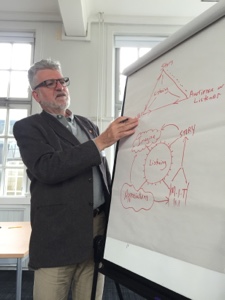
The first morning started with Michael Williams, our storytelling facilitator and guide, telling us that, 'In the end, you need to tell a good story in your thesis and defence'. We discussed the importance of engaging stories that connect with the audience and allow our stories to resonate with them. Our first activity involved using the metaphor of a tree to have us visualise and draw the outline of our stories. We started with the roots to show our diverse backgrounds and motivations for conducting the PhD. Then we moved on to show the root of our work, including the systems and people supporting our journeys. Next we moved to the leaves to show our aims, the fruit showing where we get our energy and passion, and what nourishes us throughout the journey. Finally, we drew the compost bin of things we have already gotten rid of or want to get rid of (such as anxiety or fears of not being good enough to survive this journey).


Next, we went around the circle one by one to share our personal stories and listen to others' stories about their PhD journey. This was a pivotal part of the workshop, since we went to being individual PhD students in the same workshop to developing a sense of community with trust and support in the room. Since I am a part-time student who is not often at Moray House, I knew some of the participants but I didn't know much about their research. For those who I knew better, I had talked with them or had watched their academic presentation of their work but I didn't know their motivations for undertaking the PhD journey. It was wonderful to hear everyone's story, not selecting just a few people to volunteer, because it helped our group come together knowing that everyone would share their story, and everyone would also listen to and give appreciation for others' stories. We were putting ourselves into the story of our research by showing our personal motivations and sharing our motivations and aims.


Through the sharing of our stories and giving appreciation for others' work, it was wonderful to see themes and synergies arise between our research. Many of us are looking at how to tackle inequalities, inclusivity of diversity, and how to tackle complex problems in today's society by using education. Several of us are also looking at creativity and play in different levels of education, and it was wonderful to hear Patrick's definition that 'creativity is the empowerment of people, allowing their voices to be heard. As I discussed in a previous blog post, creativity and play is a theme that I want to look into more and read up on in my own work. Many of us are working to engage students in their own learning, from the nursery level to primary, secondary, and higher education levels too so it was helpful to hear different perspectives on that. It was courageous that many shared their fears of education not being valued by society or that they don't have what it takes to excel in academia, but it was wonderful to see the hope that all of us have that our work can effect positive change in the world around us.


After the first day of the workshop, I think we all felt excited yet exhausted from the mental work of the day searching inside ourselves to tell our story and listen, sometimes emotionally, to others' stories. We returned for the next day of the workshop with anticipation of new workshop activities helping us to tell our story and to pass through the Hero's Quest. This second day began with a fun activity to help us listen to a partner's story, only asking 'why' and helping them delve deeper into their story. Then, we began role playing the PhD Hero's Quest, with one PhD student making the journey and entering several stages of thoughtful questioning by the others. It was an extremely helpful experience to think of what the viva may entail, and it was also extremely supportive.


Participating in the storytelling workshop was a great experience and I was so glad to see it come together. I developed better connections with my PhD peers, personally by connecting to the story of what drew each of them to their research and also academically by finding connections my their work and my own. I also found it an extremely beneficial experience for stepping back and reflecting on my own journey while practising telling my story and learning how to engage audiences better in future presentations and other situations. I think all of us recognised the clear need for other such workshops that help develop our personal skills as well as our professional skills, promote reflection, and allow us to enhance both our pastoral and academic experience as a PhD student. For me, it drew me into our PhD community and was invaluable in helping me to develop strong connections with my PhD colleagues. I hope that others will organise similar workshops in the future! A massive thank you to the EUSA Schools Fund, EUSA Global Fund, and the Moray House Graduate School for providing the funding to make this possible. 


Wednesday, June 29, 2016

The Work and Benefits of Student Engagement

It’s been nearly five months and the big day has nearly arrived – in this time, I have not only been researching student engagement as a PhD student and working full time, but I have also been working with three other PhD colleagues (Carla, Krystallia, and Rebekah) to apply for funding and plan an innovative storytelling workshop for our colleagues. As I’m pretty busy with my job and PhD (some say I'm crazy!), I was at first apprehensive about taking on the extra commitment of helping in this endeavor. However, I felt I should practice what I preach and do a bit more engaging in my student role to contribute to the PhD community at Moray House Graduate School of Education and Sport.

Carla, Krystallia, Rebekkah, and I have written four funding proposals, three of which came together from the EUSA Schools’ Fund, EUSA Global, and the Graduate School to generously fund our endeavor. Throughout this time, it has been a great opportunity for me as a part-time PhD student to get to know these colleagues better and work collaboratively with them which has been beneficial when PhD work can be so solitary. It has helped us develop our resilience and perseverance to write the funding requests, liaise with funders, the storyteller, caterers, etc. When we launched the event, it was fantastic to see all the spaces fill up within 24 hours showing great demand even in the midst of summer holidays. It is now with great anticipation and satisfaction that we’re looking forward to seeing our event come together tomorrow as ‘Telling the Story of Your Research: A 1.5-Day Storytelling Workshop for Academics’. You can follow our journey at #MHresearchstories on Twitter to see how we get on.

We’re hoping to see many benefits of the workshop tomorrow, seeing our PhD community come together whilst learning about each other’s research. We will also learn to communicate more effectively, reflect more on our research journey, construct new knowledge, and capture the complexity of our research in an audience-friendly manner (not bore them!). Personally I’m hoping this workshop will help me to improve my presentation skills in telling the story of my research to engage various audiences, and I look forward to hearing feedback from my peers whilst enjoying the event.

I hope we will see more such student-organised events in our community soon!

Friday, June 17, 2016

Dewey: Education, Social Justice, and Democracy

Today I participated in the conference 'Education, Social Justice, and Democracy: Critical Issues in 21st Century Education'. This was a Philosophy of Education Society of Great Britain event celebrating the centenary of John Dewey's influential text Democracy and Education, focusing on social justice and inclusion in 21st century education. I was delighted to have the opportunity to present preliminary findings from my own research in a talk called Co-Creation of the Curriculum: Living Democratic Values in Learning and Teaching, drawing on Dewey's democratic ideals and showing how many academic staff participants in my study were motivated to co-create the curriculum with their students by wanting to facilitate democratic engagement in the classroom. Furthermore, co-creation of the curriculum helps students draw on past experiences inside and outside of the classroom to engage them with current learning that is more accessible, inclusive, and rewarding since it is relevant to their own goals and interests.


Several of the talks focusing on primary and secondary education helped me reflect in new ways on my own research. In particular, I saw parallels between Diana Murdoch's research on inclusive education and themes in my work including the feelings of isolation and invisibility when a learning environment doesn't foster care and the inclusion of all voices in the classroom at any level of study. I see co-creation of the curriculum as an opportunity for developing community, care, and inclusion in education. Furthermore, co-creation of the curriculum is often referred to as a fun and creative process that engages both students and staff to learn from each other. The presentation by Adrian Skilbeck highlighted Dewey's notion that play should occur across the curriculum by engaging students imaginatively and creatively to combine work and play in learning. I was particularly struck when he noted Dewey's idea that the role of teachers is to foster engagement, inquiry, and playfulness; I would like to explore these concepts in my own research. Furthermore, Holly Linklater showed her work in which pupils have 'co-agency' in primary school classrooms alongside staff so that pupils' exploration, choices, and reflections create dynamic learning environments when teachers build community in the classroom and attend to the imagination, individuality, and co-agency of children. It is great to see co-creation of the primary school curriculum and to think about why co-creation of the higher education curriculum is considered more controversial.


A keynote address by Prof Leonard Waks who summarised Dewey's ideas that education should emphasise engaging experiences that help students to practice democratic means that help them develop as stronger actors in a democratic society. Like I do in my work, Waks highlighted the necessity of engaging students in learning and continuous readjustment within the context of an ever-changing world. Waks then tried to relate Dewey's ideas of democracy in education to the idea that the Internet has produced Education2.0 which is liberating students from a reliance on single sources of information and single conceptions of knowledge. However, Waks' superficial and idealised view of Massive Open Online Courses (MOOCs) stimulated good critique from the audience of why we need to look more closely at some undemocratic aspects of MOOCs.


Another theme that I took away from a different set of sessions was how Dewey's work on democracy and education highlights the importance of informed participation of citizens in multicultural democracies. Presentations highlighted the importance of multiculturalism and informed learning about Islam in American schools to recognise cultural diversity and accept differences (Liz Jackson), using education to understand the causes of injustices against women in Iran and look at how to include them more widely in the workforce (Hoda Mobasseri), and using citizenship education in Pakistan to promote social justice (Khurshid Sana Kahn).