Thursday, June 8, 2017

Reflections on the 2017 Enhancement Themes Conference

This week Quality Assurance Agency Scotland is running its Enhancement Themes conference, which is a great opportunity to meet staff and student union colleagues from across the Scottish sector and also international visitors from farther afield. I have attended the conference the last two years (see my reflections on last year's conference) and this year have only been able to attend the first two days of the conference but wanted to share my reflections on the presentations and discussions thus far.


The conference got off to a great start with a keynote address by Peter Felten from Elon University who I know through his great work on student/staff partnerships in developing the curriculum as well as his related work on transformational learning and student success in university. Peter warned against moves from the private sector to ‘unbundle’ higher education to focus solely on developing students’ competencies and skills in a consumer-focused, marketised manner. He highlighted how underserved students fare worst in unbundled, unstructured education (and succeed with structure and community and clear pathways to goals) so those with high social capital are more likely to succeed in an unbundled higher education environment. Peter then focused on his recent work on The Undergraduate Experience which focuses on six key areas: learning, relationships, expectations, alignment, improvement/enhancement, and leadership. By working in partnership with students to motivate them to put in meaningful time and effort on their studies, show them staff have confidence in their abilities, and allow students to practice in a safe community, students will learn how to navigate the complex world we live in today. Peter’s talk inspired the audience and also offered tangible and practical examples to help educators help students in active learning within vibrant academic communities. He used a great analogy of how a relay race team may have fantastic individual competitors, but they may lose the race because of their failure to pass off the baton between themselves; similarly, in higher education we can have silos of excellent practice but the key to success is the integration and coherence of the student experience. I really enjoyed Peter’s keynote, and one of the best parallel sessions was the discussion with Peter of the themes he had raised and the strategies to overcome challenges that we face in different higher education institutions to embed a culture of student/staff partnerships, whether it be through having lunch with students, hiring students as our research assistants, or normalizing office hours in rocking chairs in common areas.


As in other recent years at the Enhancement Themes Conference, it was a great time to learn about innovative initiatives to help students transition into, through, or out of their degree. It was great to hear about Edinburgh Napier Students’ Association’s dissertation conference of talks and workshops for fourth years before starting their dissertation, as well as a University of Glasgow research conference for fourth-year students to present their dissertation work. This gave me lots of food for thought when thinking about developing a Rep Conference for current or previous student representatives to share their work and past successes as well as talks and workshops to help Reps develop their skills and become more motivated in their role.


I also enjoyed learning about Glasgow School of Art’s interactive game ‘How to Fail Your Research Degree’ to help postgrad students think through all of the pieces of their research degree. It was great to reflect on how I could turn something like our Class Rep training into an interactive game following this model to help Class Reps with experiential learning, problem-solving, and understanding the dependencies between different stakeholders in the student representation system. This may also be a fun way to make training more interesting, practical, and rewarding for Reps to work through scenarios and develop confidence in dealing with them, but it could take quite some time to develop (especially if it were to be online!).


I really enjoyed presenting at the conference as well. I tried out the petcha kutcha format with my colleague to present on Measuring Impact in Student Representation: Incentives, Recognition, and Reward. It was a very quick six minutes flying through twenty slides (with only twenty seconds each), but we were able to summarise and share our work on HEAR recognition, Open Badges, the Edinburgh Award for Representing Students, and the Impact Awards for student leaders. By moving to a multi-faceted reward and recognition structure which focuses on the Reps’ active engagement with the role, we could share our work at the Students’ Association to incentivise students towards recording and sharing their impact in the role, rather than simply rewarding them simply for signing up. I was also able to present on the Teaching Awards research project ‘What Does Good Teaching Look Like to Students?’ (see the full report) which was fantastic to share in this venue. The research highlights the themes of student perceptions of excellent teaching and student support. Since we have shared the work quite a lot across the University of Edinburgh, it was great to share it with colleagues across the sector and to receive the feedback ‘Great work… Student-defined excellence is absolutely leading the conversation in Scotland’ showing how students and Students’ Associations have so much to contribute to discussions around teaching excellence.  


Although it was not a particular focus of the conference, I enjoyed the discussions in sessions and on the twitter wall which emerged around students as partners. Peter Felten suggested that staff can have more conversations about the qualities of the best students they have taught, Megan Brown highlighted how many staff nominate student leaders in the Impact Awards, and Matt Adie and Amy Eberlin highlighted (like I did in my talk) the importance of students recognizing excellent staff. Mushtak Al-Atabi emphasised the importance of seeing others not as ‘the other’ but as a resource and expressing gratitude for others (which is correlated with happiness). He argued that this will help us to work together with emotional intelligence and cognitive intelligence to build bridges and solve some of the massive global challenges we’re facing today. Dragan Gasevic discussed digital skill development and awareness for both students and staff, and how learning analytics data can help both students and staff. It can help students achieve their potential and staff to improve their teaching practices to better reach and engage students, and how it is important to involve different stakeholders in these discussions (including students!). NUS Scotland President Vonnie Sandlan urged university staff to work with their student representatives and student unions to improve the student experience. It was also great to hear Sally Mapstone mention an example of students and staff working together in a liberation of the curriculum project and say: ‘We ask our students to go out of their comfort zones and to challenge themselves, and we must ask ourselves [as staff] to do the same.’ That was really powerful for me to hear, and is key to the positive, open mindset of working with students as partners.

The Enhancement Themes international conference is always big and rapid-fire, with large sessions and then six parallel breakout sessions running at the same time. Today discussions will focus on wrapping up the theme of transitions and announcing the next Enhancement Theme, but I had wished that there had been fewer keynote addresses and more time for discussion-based sessions or workshops to reflect on what we as a sector have learnt from the theme of transitions, take stock of how far we’ve come in the last three years, and also not beat around the bush about what other work there is yet to do in this area. The Twitter discussions also highlighted some bubbling areas of contention or worry, such as how much time enhancement activities and partnership work takes both staff and students albeit to great success in the end. There were other questions around what expectations are for student engagement (engagement for giving feedback bribed by pizza for example, versus reciprocal partnership work throughout a project and a transparent sharing of outcomes). Someone also tweeted how student/staff partnership is not a new concept and we’ve been talking about it in Scotland for many years, yet there still seem to be barriers in fully embedding it in learning and teaching (beyond involvement of Sabbatical Officers). I hope my PhD research will help to understand the benefits and challenges of partnership work in co-creation of the curriculum, but it would have been a great time to discuss some of these deeper issues at this conference to wrap up the theme of transitions. That said, it was a very enjoyable conference to network, celebrate some of the great working taking place across the sector, and provide some food for thought.

Friday, March 24, 2017

sparqs Conference 2017

Yesterday I participated in the Student Partnerships in Quality Scotland (sparqs) conference, which was a great day of meeting students and staff to hear about their work in student engagement, particularly in quality assurance and enhancement processes. I had previously attended the sparqs 2015 conference, and I had loved the focus on co-creation of the curriculum and student/staff partnerships during fascinating talks and innovative workshops. Two of these workshops were particularly memorable for me to this day, one led by University of Lincoln where we used Legos to build collaborative environments for partnership work. The second was led by South Lanarkshire College, New College Lanarkshire, and Glasgow Caledonian University where we used helium balloons and weights to symbolise how to overcome challenges of student delivery of staff development sessions in practice. These were particularly fun workshops, and they helped me learn about great partnership work taking place across the UK.


This year’s sparqs conference had a really interesting international dimension. Shirley-Anne Somerville MSP kicked off the day with an interesting speech on how Scotland leads the way internationally in including students in quality processes, and it was good to hear her speak about how student/staff partnerships in Scottish universities and colleges are key to the wider success of the country. This was followed by Adam Gajek, Executive Committee Member of the European Students’ Union. It was helpful to hear him speak about how student engagement in quality enhancement processes helps democratise education within universities and colleges (which should model democracy for the wider society), and it also helps students to develop the skills and attributes to excel as active citizens in democratic societies. These are also themes that are arising in my research on the effect of co-creation of the curriculum in the Scottish higher education sector, so it was great to see these synergies. Adam also spoke about the threats to democracy in higher and further education as being the commercialisation of education and also students’ lack of participation. In my research on student engagement, it is also increasingly clear that not only students have the responsibility to engage but also university staff and university policies more widely need to take responsibility for facilitating students’ participation and engagement.


In the afternoon of the conference, it was fantastic presenting with two students who have been contributing to my research as Student Consultants. We presented the findings from our student focus groups to show Class Reps’ perceptions of the benefits and challenges of engaging in co-creation of the curriculum, as well as enablers to facilitate partnership practices more widely in universities. We also reflected on our own experience of co-producing research together (see my additional reflections in my previous post). They did a fantastic job with the presentation, and it was a great experience for us all working together on this research so presenting it was a great culmination of our project.

See a copy of our presentation of 'Co-Creation of Research on Co-Creation of the Curriculum'.

Our presentation was followed by two other great presentations from the University of Glasgow about co-creation and student/staff partnerships. The first highlighted a great project in which students co-created chemistry lab films to help future students prepare for labs and better understand how to complete laboratory procedures. These students were adding what they felt was missing from the curriculum and increasing other students’ confidence before going into the labs. It was great to see the positive impact of this project with the next year’s cohort receiving higher average marks (and especially seeing how the lowest mark jumped from 41% to 61%!). Not only did the co-creation experience help other students, but it was wonderful to see how the project helped the student co-creators to develop skills including teamwork, communication, public speaking, creativity, critical thinking, and digital skills. I was very impressed by their presentation, and it was also great to hear about the Press Start student-led journal allowing students across disciplines to be involved in writing, reviewing, editing, and publishing their work about gaming studies. I hope more students interested in gaming are able to get involved in the future so this project continues to grow.


In the last conference session, I really enjoyed going to the session on international perspectives on student engagement and quality assurance. Especially since I had studied abroad as an undergrad at the University of Canterbury in Christchurch, New Zealand, it was interesting to learn about their different tertiary and higher education sector and the challenges they faced including the how policies had reduced the number of student representatives and their inclusion on committees, the strong consumer model of education, and how recently membership of student unions had become voluntary and weakened the ability of student unions to make an impact. I hope that student representation can overcome these challenges to improve engagement with quality processes in New Zealand in the future. It was also interesting hearing more about the EU-funded project Enhancing Student Participation in Quality Assurance (ESPAQ) in Armenia, especially since I am really looking forward to visiting Armenia in a few weeks to contribute to this project! I’m looking forward to sharing more about this experience in the coming weeks.

The 2017 sparqs conference was a really interesting and varied one, and it was great to conclude it with the sparqs awards. I was delighted that our Teaching Awards research project on student perceptions of teaching excellence was shortlisted for the award recognising the best Scottish partnership initiative between a University and a Students’ Association. Sadly, we did not win but it was fantastic that Edinburgh University’s Project Myopia was runner-up for the best student-led project to promote equality and diversity! Well done to them – it was fantastic to see these students’ co-creation of the curriculum project being recognised for its impact in liberating and diversifying the curriculum.


Monday, February 27, 2017

Reflections on Co-Researching Co-Creation of the Curriculum

In my application for Innovative Initiative Grant funding for a project researching student and staff perceptions of co-creation of the curriculum, I felt an innovative aspect of this project could be involving students as research consultants. Their role was to contribute the student perspective to analysis of the student focus group data, and to help co-lead the focus groups for academic members of staff. Therefore, I would be able to experience an element of co-creation within my research on this subject, so it was particularly relevant and topical. I was delighted to receive the small grant which would enable me to compensate the Student Consultants a bit for their work. This project was also accepted to be presented at the Student Partnerships in Quality Scotland (sparqs) conference in March 2017, so another great opportunity arose at that conference for the students to co-present the work together with me.

I wasn’t nervous before leading the student focus groups with student representatives since this was not too dissimilar to other events I run at the Students’ Association to contribute to student representatives’ training and skills development. This time, though, I was excited to share my own work and the area of student/staff partnerships in co-creating the curriculum with them since I wanted to share this interest and I thought many would be interested in this idea. What I was nervous about ahead of the focus groups was in how to present the Student Consultant opportunity. What if no one was interested?

Risk is a theme that has been arising in my qualitative data from interviews I previously conducted with both staff and students who have participated in co-creation of the curriculum. Staff felt a sense of risk that students would not engage with their work, and another sense of risk in not knowing the direction of their collaborative work to develop an aspect of the curriculum together since this would depend on the ideas and consensus within the group. Furthermore, students can feel a sense of risk in taking more ownership over their learning, feeling more accountable to the learning community than in traditional courses, and not knowing what to expect from this non-traditional teaching. However, it was interesting for me to feel this sense of risk and nervousness myself while I wondered if any students would want to work with me on the project. If they didn’t, then a core aspect of my ‘innovative’ project would not work and it would no longer be very novel. Therefore, I put in quite some time into designing a handout to promote the role and getting the wording right so it was clear yet hopefully enticing and not over-promising anything or asking too much of the students.
 

Luckily for me, I had five students email me to express their interest in the two Student Consultant roles. It was a difficult decision because all of the student focus group participants had provided valuable contributions, and especially these students. Two students in particular wrote about how much they had enjoyed the project, what they could contribute to it, and what skills and experience they felt they could gain by participating – I offered them the roles but it was difficult turning the other students down.


We have now met once to co-analyse the focus group data, after finally finding a time we could all meet. We had all read through the transcripts of the two focus groups (about 20 pages each!) and the students had been very conscientious in their preparations and notes about their reflections which led to a valuable discussion. We had very similar interpretations of the data relating to students’ aims in higher education, students’ views of effective teaching, and their perspectives on student engagement. All of us had been surprised that the first focus group (which neither of them had been a part of) had been a bit negative about the idea of co-creation of the curriculum. Several participants in that focus group had complained about the heavy workload of preparing ahead of a flipped classroom experience, they felt there was no benefit in attending if they did not have time to prepare adequately, and even when they had prepared some of these students had felt that the discussion was too ‘out of the box’. Both the Student Consultants and I were surprised that these participants had previously spoken about the need for students to take responsibility for their learning experience; furthermore, they had voiced the view that effective teachers should adapt to students’ interests and act on students’ feedback to improve the course as it takes place. Therefore, we felt it was contradictory that these participants had highlighted many challenges to co-creation of the curriculum when, in other parts of the discussion, it seemed that they would have benefited from and enjoyed experiencing co-creation of the curriculum. By contrast, the second student focus group (which both Student Consultants had been part of) was generally very positive about the opportunities that co-creation present.


We are still analysing the focus group data, and we are preparing for leading the two focus groups with staff on 10 and 13 March
. One of the Student Consultants has volunteered to create the short PowerPoint sharing the general consensus from the student focus groups, which will be presented after the staff share their perspectives so that we can discuss the comparison. My first gut reaction was to think ‘What if the presentation isn’t good?’ but immediately I felt that it would be ok since part of the process of co-creation is letting go of ownership over the direction of the project. From what I hear from staff who have done this, often the students go above and beyond the staff members’ expectations and produce exceptionally high-quality work when they’re given this opportunity. If they don’t, then we can have a productive discussion and give each other feedback to improve the presentation, but I’m confident I’ll be pleasantly surprised by the output. We’ll see!

Update: read more about our presentation and experiences at the sparqs conference.


Saturday, January 21, 2017

The Power of Co-Production: Transforming Ourselves and Our Society

Today was a thought-provoking day attending and presenting at the conference 'Co-Production, Research and Youth and Community Work'. Dave Beck’s conference introduction started the day rightly linking co-production to social justice and community development that decrease inequalities and effect positive change in civically engaged democracies. Co-production helps to develop shared ownership as opposed to chasing extrinsic motivations and targets for their own sake. It was good to start the day with these themes which would re-emerge in numerous presentations and workshops. In particular, this fit well with the opening presentation from Young Edinburgh Action’s young people and staff. I was particularly struck by how they said they created ‘safe spaces, and brave spaces’ for young people to participate in co-production and have a positive impact on their community. 
As I have found in my emerging research, community development, trust and respect are key to developing and working effectively within safe spaces; at the same time, co-production challenges traditional power hierarchies and stereotypes about what young people are capable of, so co-production also needs to be ‘brave spaces’ that challenge the status quo and think creatively to tackle challenges in the classroom or community, and beyond in the wider society. Preparations for my workshop helped me articulate my initial analysis of some of my data from staff and students who have participated in co-creation of the curriculum, and I was glad that it led to fruitful discussions of the democratisation of knowledge, sharing power amongst a collective, and developing power within individuals.
Other presentations brought this out for me by discussing how co-production is fundamentally a developmental process of empowerment. Within safe spaces, people can bravely experiment and learn creatively from challenge whilst developing personally and professionally as individuals and whilst developing society’s capacity to confront some of the most difficult challenges of today’s uncertain world, such as inequality. By developing personal agency and empowerment, we can learn to understand ourselves better by demonstrating reflexivity and transparency. By working in partnership with others in co-production projects, it can be an emancipatory, transformative and holistic process that is rooted in individuals’ personal stories and in real life. Although co-production is ‘messy’, challenging, and involves risk, it was helpful to see that others agreed that its transformative power often outweighs these challenges since it has the ability to change ourselves and our society for the better.

Wednesday, July 20, 2016

Reflections on HECU8

Higher Education Close Up (HECU) #8 was a wonderful conference that examined the theme of social justice in depth and from multiple angles and perspectives. Bringing together higher education researchers from the UK, South Africa, Australia, the U.S., and beyond, this conference wrestled with difficult questions about the purpose of the university. We discussed the extent to which we are researching how to develop higher education institutions that are socially just and/or whether higher education can lead to the development of a more socially just world. This conference raised so many deep and important questions about social justice and higher education that will take us all quite some time to think through, but below I have attempted to summarise some of my reflections from the past few days.

Jenni Case set the scene with her keynote asking whether we are asking the right, forward-thinking, impactful education questions to fully understand the current context that is rapidly changing. She highlighted how 'close up' research is undervalued, and how academics need to not just write opinion nieces, blog posts, and social media posts that are short-term and focused on the moment at hand; we need to not lose sight of the long-term aims and conduct forward-thinking research about social justice in higher education. Similarly, Monica McLean suggested that higher education is of diminishing importance for disadvantaged groups, and students from lower socioeconomic status are more likely to enroll in lower-ranked and lower prestige universities. She highlighted the need to understand in a nuanced way what epistemic injustice looks like, and also what justice and spaces for hope look like in within higher education.


During the three days of the conference there was a range of presentations about inequalities in higher education, as well as hope by seeing some very positive projects. For example, Kirsty Finn highlighted that some student mobility focuses on maintaining or reproducing class, power, and privilege. She showed that this is seen especially within discourses of cosmopolitanism about students who have the ability to move within the country or around the world to pursue educational opportunities. However, she used the capabilities approach to try to shift the debate about student mobility and show the advantages for student commuters who can see their long commutes as opportunities to create physical and symbolic distance between their home and university which allows them to reflect on ideas during their time commuting. Other talks looking at inequalities in higher education included Kelly Coat who is researching gendered inequalities of prestige for mid-career female academics, Samuel Dent who is researching support for and recognition of students who care for children, and Joanne Doyle who is exploring the challenges of bringing higher education learning initiatives to incarcerated students in Australia and the benefits when they have fewer instances of being re-incarcerated. In addition, research from Kingston university showed attainment gaps for white and black students although there is hope because they have introduced successful ways of developing students' social capital which appear to have improved attainment rates for all students.


Paul Ashwin and Rachel Sweetman's talk on the stability of higher education ranking systems that reproduce prestige was also fascinating, and they suggested more socially just measures of teaching quality. They highlighted the importance of looking at students' perceptions of their learning experiences and their reports of whether transformative learning takes place in their classrooms. They also highlighted the public perception of precision in ranking systems, but they showed that this is not the case in reality so it is more advantageous to use blunt measures of teaching quality so that the public can more easily recognise the obvious benefits and limitations of university ranking systems.

Another theme of the conference was the importance of developing strong student-teacher relationships in socially just higher education that minimizes inequalities. Her her keynote, Jan McArthur highlighted that self-realisation and social inclusion are interconnected, encouraging both students and teachers to give and receive in learning and teaching. She emphasised three aspects of mutual recognition in higher education: love, rights, and merit. This included emotional support to develop self-confidence, equal treatment including cognitive respect and moral responsibility that encourages self-respect, and social solidarity that develops self-esteem by contributing to society. She questioned, 'if assessment is so important, why can't it be more socially just?' And highlighted lack of trust and honest in assessment from the plagiarism industry's effect on assessment to inappropriate emphasis on knowledge that priviledges economic value (such as employability). Jan stated that, to promote social justice in higher education, we need to have assessment that promotes self-confidence, self-respect, and self-esteem. Furthermore, Jan called for social justice work in higher education that to be in conversation with the world as it is currently, and as it might be if it is indeed socially just.

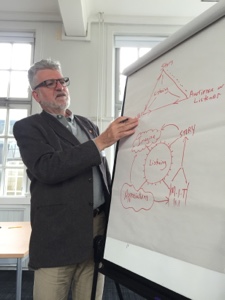
(photo from my presentation is with thanks to Vicki Trowler)

In alignment with this, I did clearly see a case for hope. I presented on how I see co-creation of the curriculum as an opportunity to promote a social justice purpose of higher education: 

  • by creating inclusive and safe spaces for students and academics to work in partnership, 
  • by increasing student and staff engagement with learning and teaching, and 
  • by modeling democratic engagement and social justice in the classroom with the hope that what is learnt can be taken forward to tackle complex global problems and inequalities.
See my conference paper Co-Creation of the Curriculum and Social Justice: Changing the Nature of Student-Teacher Relationships in Higher Education. While on the surface there seem to be differences between each of our different contexts, I also saw strong similarities and that we can learn from each other as individuals are working in South Africa is to de-colonize the curriculum, in Australia to embed cultural competence in the curriculum, and in the UK and the U.S.to diversify and internationalise the curriculum (instigated by the 'why is my curriculum white?' campaign in the UK and Black Lives Matter in the U.S.). As Paul Ashwin reflected at the end of the conference, the curriculum is not natural since there are many choices and clear power dynamics at play within it, so it's important to be transparent about those choices and their impact. There is lots more to do and more 'close up' research needed, but it's important to understand fully the challenges and risks so that we can to try to reduce inequalities and create a more socially just world. I left this conference with many more questions than answers, but that is extremely positive since it was such a valuable experience to be part of this conference and emerging discussions about social justice and higher education.

Monday, July 11, 2016

Tips for Creating Open Badges

After I first heard about Open Badges two summers ago, I was keen to adopt them into my work in academic engagement at Edinburgh University Students’ Association and over this time the project has been extremely successful. Open Badges are flexible, free, digital forms of accreditation that are full of information (metadata) about what individuals have done to earn them. They are open source and hundreds of organisations and companies around the world use them. The Open Badge scheme I set up at Edinburgh University Students’ Association was the first Scottish higher education scheme, but now increasing numbers of universities across the UK and around the world are adopting them – the more Open Badges are used, the more widely recognised and valuable they will become.

This past year I have tried to share my experiences of setting up an Open Badge scheme with as many people as possible within the higher education community. I have published a case study about my experiences of setting up and piloting Open Badges, led workshops at conferences to help others learn how to incorporate Open Badges into their own work, and responded to many enquiries from individuals across the country.

I now want to consolidate all of my tips in one place, so keep reading to see my advice!

Clarify Your Aims: How Will Open Badges Benefit Students and How Will they Benefit Staff?
I have found that Open Badges have a large number of benefits, but it’s important to be clear about how they benefit students (i.e., why they should bother earning them) and how they benefit staff at your organisation (i.e., why it’s worth the effort to develop them). Below are examples of benefits relating to the support I give to Class Reps at the Students’ Association.

Benefits for Students:
  • Better understanding all aspects of the role, and serving as stepping stones to the Edinburgh award for representing students
  • Reflecting on and documenting their work
  • Sharing best practices with Reps in other schools who may be working on similar issues
  • Sharing their work & successes with the students they represent (see examples of anonymised blog posts on our Schools pages in the ‘news’ tab for each)
  • Earning open badges and adding them to their LinkedIn profiles
Benefits for the Students’ Association:
  • Fewer questions about the Class Rep role and, in particular, what activities are part of the Edinburgh Award for Reps
  • Learning more about the local work of Reps in their School (there are over 2,000 Reps at Edinburgh University who work locally within subject areas and Schools)
  • Learning more about the impact of the student Rep role on students’ personal and professional development
  • Having access to fantastic blog posts that we can include on our Schools webpages
  • Providing a new form of recognition for our Reps who are volunteers (see more in the sparqs accreditation report – my example of Open Badges is on pages 10- 12)

Think About the Bigger Picture: Develop Clear Criteria and a Framework for Your Badges
While you can create a one-off Open Badge, it’s best to think about the bigger picture: will your Open Badges be part of a framework for your activity, or within a bigger framework with your organisation? You should have a think about what activities you want to incentivise students to take part in and make sure this fits in with the benefits you aim to have for your scheme. If others within your organisation also offer Open Badges, how will your scheme fit in (separately or together?) and will it be the same level of difficulty to earn badges offered by different areas of your organisation?

For Class Reps, you can see the image above of the many activities we see as part of the Class Rep role. When students earn three badges in one category, they will earn that category-level badge. When they earn all three category-level badges, they will earn the Class Rep Gold Badge. Based on feedback from students we didn’t create a bronze, silver, and gold scheme since students didn’t like the idea of going from all being equal to suddenly being in a tiered scheme. We wanted to give Class Reps lots of choice and flexibility so we developed these broader categories.

For the criteria, we usually required students to use a blog post to explain: what they did and what the impact was for themselves and/or others. For example, in the Implementing Change badge acknowledges the Class Reps who schedule individual meetings with University staff members to bring their peers’ concerns forward and find potential solutions. Students will have to write up a brief report on their work implementing change, including:                      
  • the problems they raised with the staff member                                                   
  • the solutions they proposed     
  • staff response and action                                                                         
  • how the Rep communicated with other students to let them know about the positive changes that were implemented (or the reasons why the idea could not be implemented)
Learn How the Technology will Work for You
Open Badges can be ‘triggered’ by different things. In my understanding, there are three ways to issue an Open Badge:
  • Successful completion of an online quiz or online module (automatic badge release upon minimum threshold grade being achieved – we use this for when students earn over 80% on our Class Rep online training quiz and they earn the online training badge)
  • Participation in an event, training, conference, etc. (manual grade centre updates to trigger badges – we use this to input attendance into our virtual learning environment to issue the intermediate training badge)
  • Graded blog posts (manual grading is needed here and we have student staff members help with this, but we use a grading scheme as simple such as 0 for not meeting badge criteria and 1 for meeting the criteria and issuing the badge)
There is different technology to issue Open Badges, including many virtual learning environments such as Blackboard and Moddle. You can also use Cred.ly and Wordpress’ Cred.ly plugin, although I’m not familiar with how that works. Edinburgh University uses Blackboard where Open Badges are an Achievement (find them in Course Tools -> Achievements area -> Create Achievement). I’d recommend the ‘milestone’ or ‘completion’ options for Open Badges.

Before setting them up, make sure you have:
  • a good name for each badge that students and others outside your organisation (such as employers) can understand
  • a description including the criteria needed to earn each Open Badge
  • a specific grade centre column to link to each badge (badges will be triggered when grade is equal to or greater than 1 in my case)
  • an image for your Open Badge
You can choose one of the existing images in Blackboard or using any technology you can upload your own design for your Open Badge, and make sure to publish the badge to Mozilla so that it can be included in the Mozilla Backpack which aggregates badges earnt from organisations around the world. From my experience, it’s important to have attractive-looking badges or students won’t want to earn them if they don’t look nice.

Don’t Forget the Marketing and Support
It is important to get the marketing right for your Open Badges so you promote them to students by selling the benefits to them, explain what your badges are, and clarify how students can earn them. I developed handouts that I made available at various events I ran, and I also included the handouts in our VLE for Reps so they were all aware of the opportunity to earn Open Badges.

Some students I work with have never written a blog post before and were nervous about that, so I worked with colleagues to develop some optional training sessions. We offered Blogging for Reps with tips about how to write effective online content, engage audiences, and be clear about what you want to say. We also offered a peer support session where Reps would have a go at writing a blog post and give feedback to peers on their drafts. This proved really helpful.

Clarify What Success Means for Your Open Badges
In your scheme, does success mean the quantity of badges students earn or the quality of their engagement? As you will see in the infographic, our Open Badges have had strong impact in the quantitative sense with over 1,300 Reps earning at least one badge (for the online training). However, we were just as interested in the quality of engagement of our Reps, and as you will have seen in the Benefits section above the Open Badges helped Reps reflect on their experiences and helped us learn about their work across the University. We learnt about how they developed communications, change management, and leadership skills as well as much more! See my case study in the Journal of Educational Innovation, Partnership, and Change for a fuller look at what this qualitative impact meant for us.

Need More Support than I Can Offer?
I hope by sharing my experiences and tips this has helped you to think through how to create your own Open Badges. You can find lots of great resources to help you create them at http://openbadges.org/http://openbadges.org/ and http://www.digitalme.co.uk/.

Sunday, July 3, 2016

Telling the Story of Your Research

During the end of last week, I was thrilled to participate in the workshop 'Telling the Story of Your Research' at Moray House Graduate School of Education. This was the culmination of five months of working with my PhD student colleagues Carla, Krystallia, and Rebekah to gain funding, plan, and develop this workshop (see my blog post on our journey). On Thursday, fourteen of us PhD students came together for the first time to reflect on our own PhD journeys and share them with each other.


The first morning started with Michael Williams, our storytelling facilitator and guide, telling us that, 'In the end, you need to tell a good story in your thesis and defence'. We discussed the importance of engaging stories that connect with the audience and allow our stories to resonate with them. Our first activity involved using the metaphor of a tree to have us visualise and draw the outline of our stories. We started with the roots to show our diverse backgrounds and motivations for conducting the PhD. Then we moved on to show the root of our work, including the systems and people supporting our journeys. Next we moved to the leaves to show our aims, the fruit showing where we get our energy and passion, and what nourishes us throughout the journey. Finally, we drew the compost bin of things we have already gotten rid of or want to get rid of (such as anxiety or fears of not being good enough to survive this journey).


Next, we went around the circle one by one to share our personal stories and listen to others' stories about their PhD journey. This was a pivotal part of the workshop, since we went to being individual PhD students in the same workshop to developing a sense of community with trust and support in the room. Since I am a part-time student who is not often at Moray House, I knew some of the participants but I didn't know much about their research. For those who I knew better, I had talked with them or had watched their academic presentation of their work but I didn't know their motivations for undertaking the PhD journey. It was wonderful to hear everyone's story, not selecting just a few people to volunteer, because it helped our group come together knowing that everyone would share their story, and everyone would also listen to and give appreciation for others' stories. We were putting ourselves into the story of our research by showing our personal motivations and sharing our motivations and aims.


Through the sharing of our stories and giving appreciation for others' work, it was wonderful to see themes and synergies arise between our research. Many of us are looking at how to tackle inequalities, inclusivity of diversity, and how to tackle complex problems in today's society by using education. Several of us are also looking at creativity and play in different levels of education, and it was wonderful to hear Patrick's definition that 'creativity is the empowerment of people, allowing their voices to be heard. As I discussed in a previous blog post, creativity and play is a theme that I want to look into more and read up on in my own work. Many of us are working to engage students in their own learning, from the nursery level to primary, secondary, and higher education levels too so it was helpful to hear different perspectives on that. It was courageous that many shared their fears of education not being valued by society or that they don't have what it takes to excel in academia, but it was wonderful to see the hope that all of us have that our work can effect positive change in the world around us.


After the first day of the workshop, I think we all felt excited yet exhausted from the mental work of the day searching inside ourselves to tell our story and listen, sometimes emotionally, to others' stories. We returned for the next day of the workshop with anticipation of new workshop activities helping us to tell our story and to pass through the Hero's Quest. This second day began with a fun activity to help us listen to a partner's story, only asking 'why' and helping them delve deeper into their story. Then, we began role playing the PhD Hero's Quest, with one PhD student making the journey and entering several stages of thoughtful questioning by the others. It was an extremely helpful experience to think of what the viva may entail, and it was also extremely supportive.


Participating in the storytelling workshop was a great experience and I was so glad to see it come together. I developed better connections with my PhD peers, personally by connecting to the story of what drew each of them to their research and also academically by finding connections my their work and my own. I also found it an extremely beneficial experience for stepping back and reflecting on my own journey while practising telling my story and learning how to engage audiences better in future presentations and other situations. I think all of us recognised the clear need for other such workshops that help develop our personal skills as well as our professional skills, promote reflection, and allow us to enhance both our pastoral and academic experience as a PhD student. For me, it drew me into our PhD community and was invaluable in helping me to develop strong connections with my PhD colleagues. I hope that others will organise similar workshops in the future! A massive thank you to the EUSA Schools Fund, EUSA Global Fund, and the Moray House Graduate School for providing the funding to make this possible.